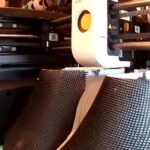
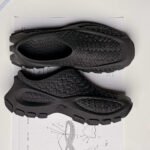
A 3D-printed sneaker made from one continuous structure does not have to be made from one uniform material. Researcher Teng Teng and collaborator Yefan Zhi have demonstrated footwear in which the mix of polymers changes as the print progresses. Their prototype combines five material formulations within a single sneaker, assigning different blends to areas that need different kinds of flexibility or support.
The work is accepted for ACADIA 2026, the computational-design conference taking place October 22–24 in Michigan. It is a research prototype, not a shoe available to buy. But it tackles a manufacturing question that commercial one-piece footwear still faces: how do you vary mechanical behavior within a continuous print without adding stitched or glued components?
Five material formulations in one printed sneaker
In the research team’s published project documentation, a US men’s size 10 sneaker is described as weighing 350 grams and using five material formulations. The researchers report 45 minutes of continuous extrusion per sneaker, with no support material or post-print assembly. That figure describes the extrusion stage as reported by the team; it should not be confused with a verified total production cycle including preparation, setup and any other operations.
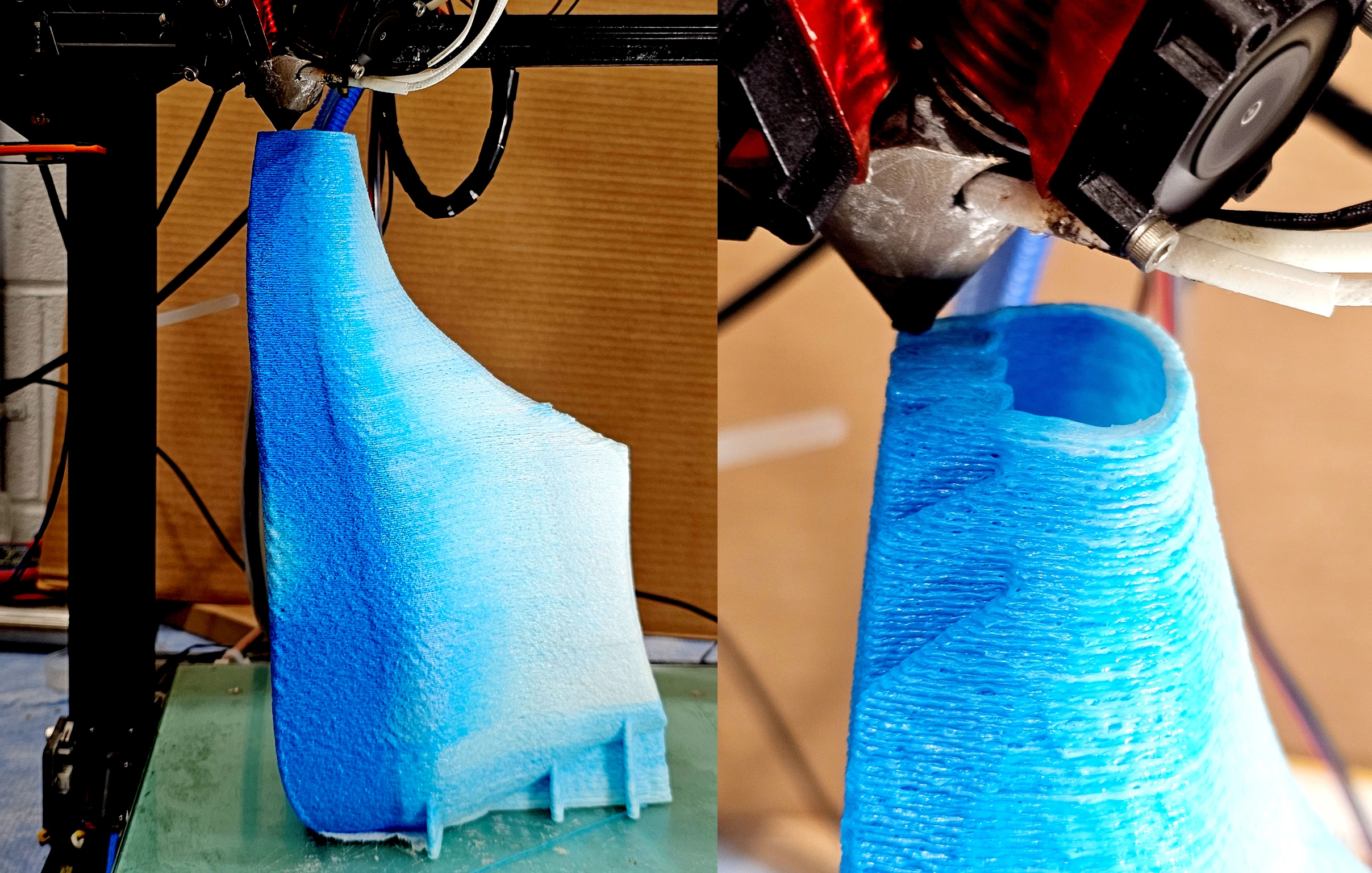
The visible shoe changes from a pale upper to blue regions around the sole and toe. Those color transitions are not simply decorative. They make the different mixtures easier to see and document. The underlying idea is to use more flexible blends in areas expected to bend and more supportive blends where the design anticipates different loads.
This differs from adjusting only the lattice geometry inside a single material. Geometry remains important, but here composition is another control. The researchers use recycled TPU and PET-G as feedstocks, along with additives that modify the TPU blend. They describe a single-nozzle, actively mixed extrusion process that changes the blend along the print path.
The printer changes the recipe while it moves
A conventional single-material print feeds the same material through the nozzle while changing its path. In this experiment, the printer also changes the material mixture. A two-stage mixing head receives multiple feeds; software controls their proportions as the nozzle deposits the shoe. The team describes compensation for material left in the mixing chamber so that a requested change in composition appears at the intended location rather than too late.
That last point is easy to miss. When materials mix inside a nozzle, switching a feed does not instantly switch the material emerging at the tip. Some of the previous mixture remains in the system. The researchers studied those transitions and incorporated a calibrated offset into their toolpath instructions. Without that adjustment, a supposedly stiffer or softer region could end up in the wrong place.
They also tested material formulations and transition specimens. The project reports hardness values spanning Shore 62A to 93A across its tested blends, as well as tensile tests of selected interfaces. These are measurements of material behavior in the research setting. They are not evidence that the finished shoe lasts longer, feels better or outperforms an existing sneaker during wear.
Simulation informs the zones, but does not prove performance
The team used simulated loading during heel strike, mid-stance and toe-off to help decide where different mixtures should go. The resulting model assigns regions according to anticipated mechanical demand. A second printed footwear shape—a women’s size 8 flat—shows that the method can be adapted beyond the original sneaker silhouette.
Those are meaningful demonstrations of fabrication flexibility. They are not a substitute for independent testing on feet. The author explicitly notes that wearer performance has not been established. There are no reported controlled wear trials showing superior cushioning, energy return or injury prevention. Nor does the prototype establish a consumer price or an available retail release.
For context, our report on independent makers and multi-material shoe engineering covers how smaller research and design teams experiment with printable footwear. Our coverage of WAZP’s on-demand footwear system addresses a different challenge: turning digital shoe designs into repeatable production and fulfillment. The Teng–Zhi work is closer to a materials-and-toolpath experiment than a manufacturing service.
Recycled feedstock is not the same as proven circular footwear
The project uses recycled TPU and PET-G and describes shredding failed prints back into feedstock. Integrating upper and sole without adhesives also removes an assembly step from the demonstrated process. Both are relevant engineering choices, but they do not by themselves establish a closed-loop shoe at commercial scale.
The researchers identify unresolved questions about recovering mixed polymers after use, long-term wear and comfort. Mixed-material parts can introduce separation and recycling challenges even when the initial feedstocks are recycled. A complete environmental comparison would need material sourcing, energy, durability, transport and end-of-life data. None is established here for a commercial product.
The ACADIA 2026 conference schedule lists the main event for October 22–24, following workshops October 19–21. The research team identifies its paper as accepted for the 2026 proceedings. That is a conference milestone, not proof that the prototype is ready for retail or has passed a shoe-industry qualification program.
A useful manufacturing question, not a launch announcement
The strongest result is that the team reports producing two footwear geometries with spatially varied mixtures through a continuous extrusion process. It suggests another design lever for printed footwear: composition can be placed alongside shape and lattice structure when engineers decide where a shoe should bend or resist load.
The next useful evidence would be repeatable mechanical testing of finished shoes, independent wear data, full production-time measurements and a realistic recycling assessment of the mixed materials. Until those arrive, this is best understood as a documented fabrication method with physical prototypes—not a finished sneaker that shoppers can order, and not a claim that multi-material printing automatically makes better footwear.
Source note: Prototype figures, methods and material values are attributed to Teng Teng and Yefan Zhi’s research documentation. The ACADIA conference dates are independently confirmed by the event organizer. 3DShoes has not inspected or tested the printed footwear.