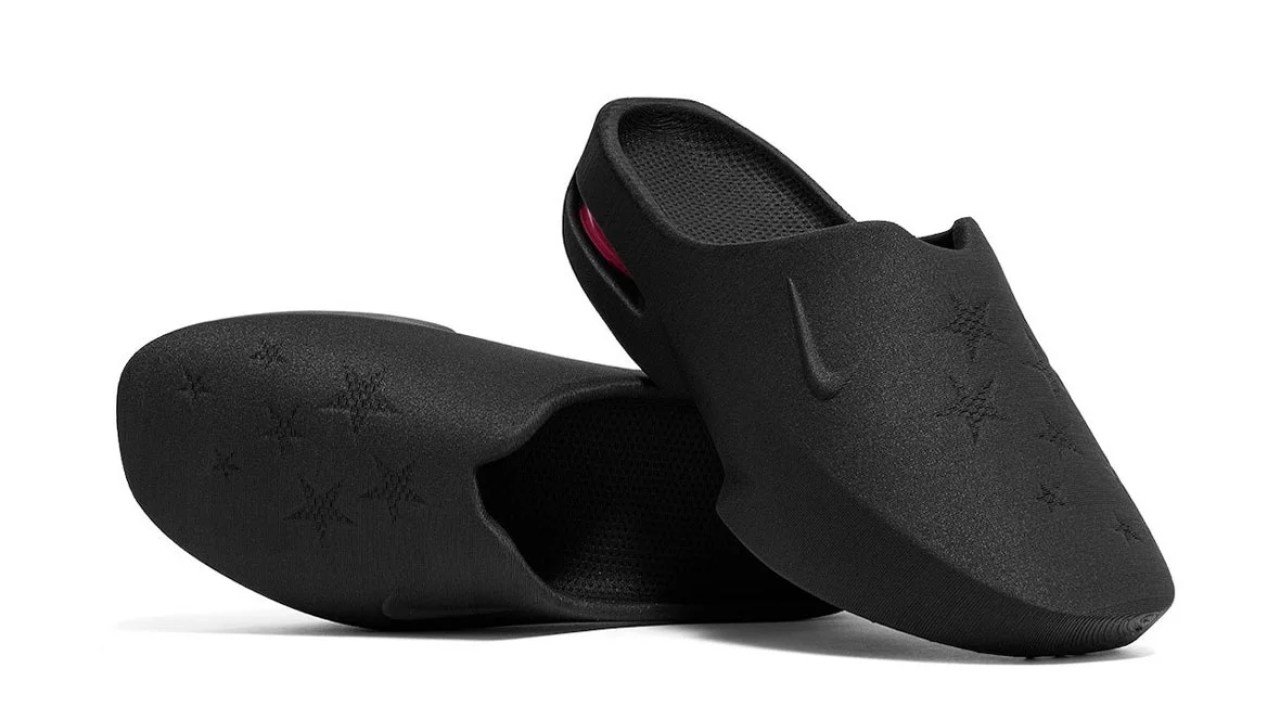
Masyn’s Nike Air Works mule is an unusual Air Max because its most memorable feature is not the Air unit. The Los Angeles designer has covered a black, backless 3D-printed silhouette with stars, including a larger star underfoot intended to leave an impression on the ground. Nike confirmed the design on October 15, 2026, as the fourth reveal in its eight-city Air Works program, developed with Nike mentors and printing partner Zellerfeld. This is a physical limited-run design, not a consumer retail launch.
The shape also deserves more attention than another routine colorway announcement. Nike’s Air Max history is largely built around recognizable sneakers with visible cushioning. Masyn uses the Air idea inside a mule: a closed front, an open rear and a printed body that looks less like a conventional stitched shoe. That change affects the design language, but it does not establish that the mule has the heel security or walking comfort of a standard sneaker.
A mule built around people rather than a celebrity reference
Nike’s October 15 newsroom update identifies Masyn as the Los Angeles participant in its inaugural Air Works class. The program invited eight designers to Beaverton in spring 2026 to develop Air Max interpretations alongside Nike teams and Zellerfeld. Nike’s release establishes the collaborator and the date; Sole Retriever’s launch reporting supplies closer product observations and Masyn’s comments about the people who influenced him.
The repeated star motifs refer to friends, family and mentors, rather than functioning as arbitrary surface decoration. The oversized outsole star takes that idea into contact with the street: the intended footprint becomes a literal reminder of the impressions people leave. It is an unusually legible connection between a designer’s story and a printed product detail. The presence of the embossed star is documented; how reliably it leaves a recognizable print on different surfaces has not been independently tested.
Why the open heel changes the Air Max silhouette
Several earlier Air Works designs kept a more familiar slip-on or enclosed-shoe profile. Masyn removes the back, placing more visual weight on the sculpted toe and sidewall. A small tonal Swoosh is subordinate to the star treatment, while a contrasting pink-to-red visible Air component gives the mostly black mule its strongest color accent. Hypebeast’s October 22 image gallery documents the finished form from multiple angles.
The result is not simply a Nike Air Max 1000 with its heel cut away. The decorative relief, open rear and community-centered theme create a different design proposition. Compare it with the Beijing Air Max Link by Marc Su, whose architecture places more emphasis on futuristic volumes and visible Air hardware. Both belong to the same Air Works experiment, but the reasons for their shapes are distinct.
The term ‘fully 3D-printed’ also needs a qualification. Nike and Zellerfeld describe the printed footwear design, but the visible Air cushioning component is separate from the printed body. We have no confirmed polymer formulation, printer model, cycle time, pair weight or independent wear-test data for Masyn’s mule. The appearance of a seamless printed upper is not evidence that every component is made in one printing operation.
What Nike actually plans to release
Nike’s original Air Works program announcement describes limited friends-and-family editions celebrated within each designer’s community. Masyn’s design was shown in West Hollywood, and Sneaker News’ October coverage places the reveal at NOVA studios. No general retail price, public purchase window, broad size run or regular online stock has been confirmed for this exact mule. A photo of a finished shoe should not be mistaken for an available shopping listing.
The sequence has also changed since the program was first announced. Nike’s updated October schedule now lists Shanghai in December 2026, Paris in January 2027, New York in February and Mumbai in March. An older Nike program release had Mumbai in November. The October 15 update is the more recent primary source. It is safer to treat those dates as planned designer reveals, not as guaranteed consumer release dates.
3DShoes previously covered how Nike Air Works was organized. This article addresses a specific completed silhouette, not a new program announcement. It also offers a contrast with PUMA’s Mostro 3.D Mule, another printed mule that uses dramatic geometry but comes from a different fashion collaboration and did receive a limited commercial launch.
What the design tells us—and what it cannot
Masyn’s mule demonstrates one strength of additive manufacturing in a small-run design setting: detailed relief can become part of the object’s structure without conventional sewn overlays or dedicated mass-production tooling for every experiment. That does not make the process inexpensive or sustainable by default. Nike has not supplied a manufacturing-cost comparison, lifecycle assessment or verified performance test for this pair.
The most useful distinction is between cultural experimentation and a product recommendation. The mule is a real, finished expression of one designer’s point of view. Its backless profile, stars and visible Air are meaningful design choices. Until Nike announces broader availability and supplies buyer-relevant information, it should be treated as a documented design project—not as a sneaker readers can order or a shoe 3DShoes has worn.
Source and verification: Nike newsroom, October 15, 2026; Nike original program background; Sole Retriever, October 15; Hypebeast photo gallery, October 22. Checked October 26, 2026. Photos show Nike’s actual Masyn Air Works mule, credited to Nike; no independent hands-on testing, current retail offer or express photo license is claimed.