



Nike has unveiled a new 3D printed Air Max from Beijing designer Marc Su as the latest entry in its Air Works program. What makes the Nike Air Max Link different from the 3D-printed Air Max concepts Nike and Zellerfeld have already shown?
Su’s design changes both the placement of Nike Air cushioning and the structure of the printed shoe, adding modular attachment points intended to make customization part of the footwear itself.
Nike Air Works Reveals Marc Su’s Air Max Link
Nike revealed Marc Su’s Air Works design on September 24, continuing the staged rollout of footwear created through the company’s inaugural Air Works program.
Su represents Beijing in a group of designers invited from cities including Tokyo, London, Los Angeles, Shanghai, Paris, New York and Mumbai. Participants worked with Nike designers and engineers at the company’s Beaverton campus, with the resulting footwear developed as 3D-printed Air Max designs in partnership with Zellerfeld.
The Air Max Link follows designs from Tokyo-based Motoi Hatsuki and London designer Tasnim. Nike says additional Air Works footwear will continue to appear over the coming months, with Los Angeles designer Masyn scheduled next in October.
The name Nike Air Max Link, used by Su and subsequent footwear coverage, reflects one of the design’s central ideas: connection points that can accept additional components.
That makes the Marc Su Air Max notable not only for its shape, but for the way 3D printing changes what can be integrated directly into the footwear.
3D Printed Air Max Changes Air Placement and Structure
One of the most visible changes is the treatment of Nike Air cushioning.
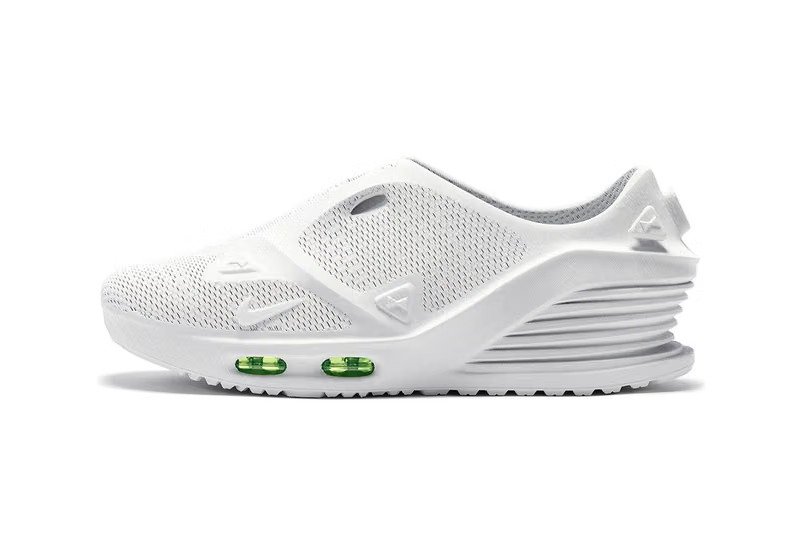
Instead of placing one prominent Air unit around the heel, the Air Max Link positions two visible green Air units farther forward under the foot. The rest of the shoe uses an almost entirely white slip-on structure, creating a clear visual separation between the printed body and its cushioning components.
The design also departs from conventional layered sneaker construction.
Visible features include:
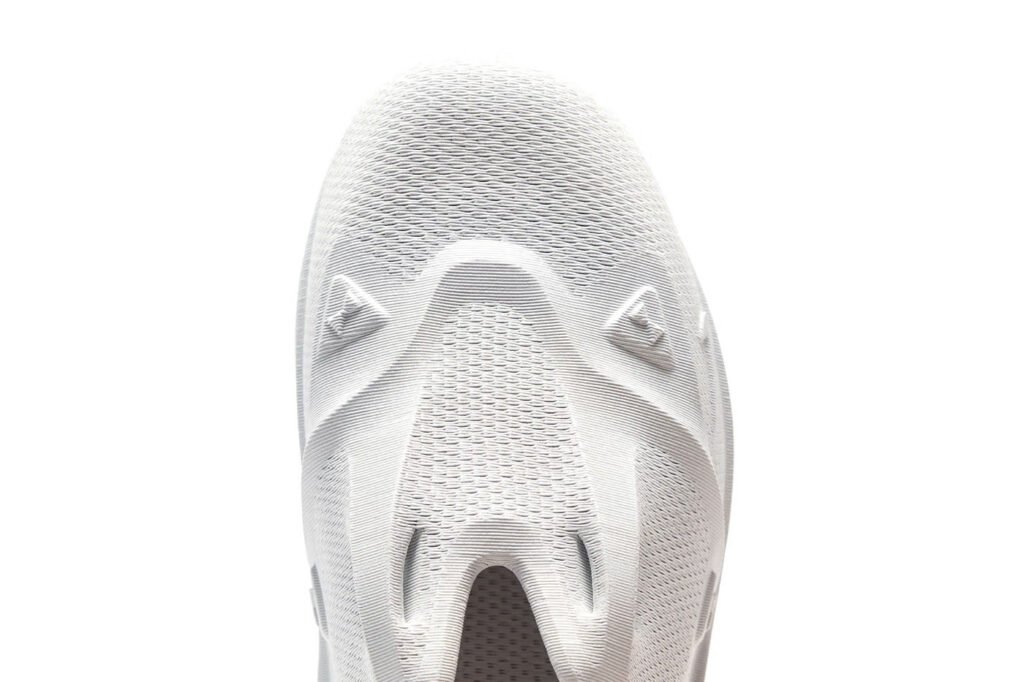
- a textured, weave-like upper
- structural lines running across the upper
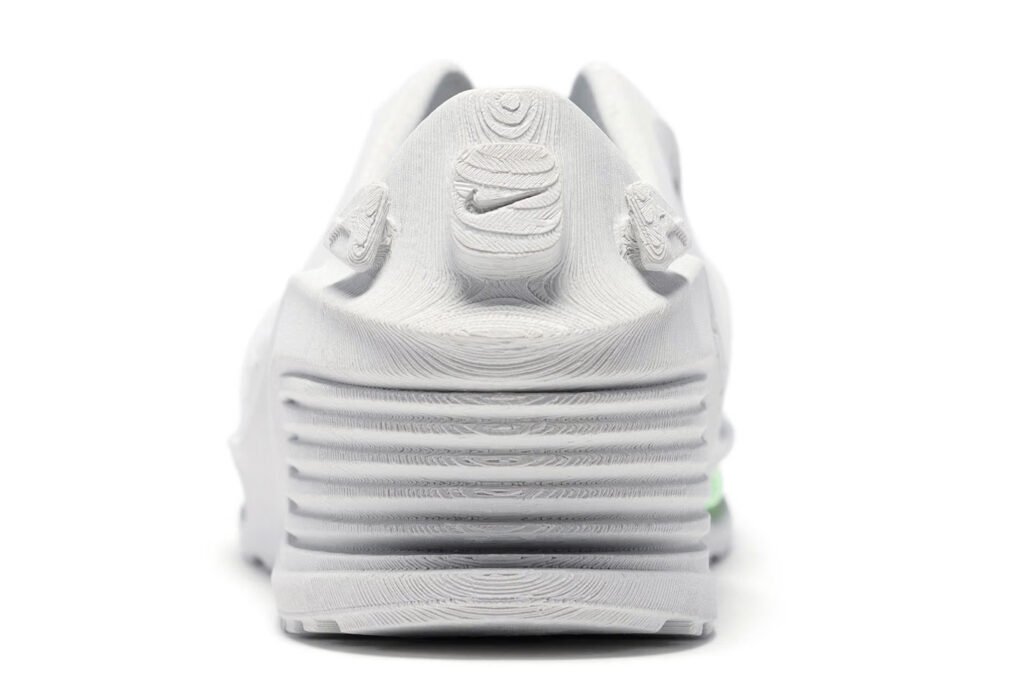
- an enlarged rear section around the heel
- geometric projections integrated into the printed form
- restrained Nike branding
- attachment points designed to accept additional components
Additive manufacturing allows several of these forms to be incorporated directly into the shoe rather than assembled from separately cut and stitched parts.
The Air Max Link is not a completely printed shoe in the strictest sense. Nike’s Air cushioning remains a separate technology integrated into the structure, combining additive manufacturing with an established footwear system rather than replacing every production process.
Air Max Link Uses 3D Printing for Modular Customization
One of the most consequential elements of the design may be what Marc Su calls its “Link Nails.”
Su said the connection points were inspired by sunmao, traditional Chinese mortise-and-tenon joinery. The protruding structures allow additional pieces to attach to the shoe, turning part of the printed body into an interface for physical customization.
That represents a different use of 3D printing from simply producing a complex one-piece sneaker.
Conventional footwear can be customized through color, materials, laces or detachable accessories, but its manufacturing method usually determines where those changes can occur. Additive manufacturing allows attachment geometry to be designed directly into the footwear without requiring separate tooling for every structural variation.
In practical terms, the Air Max Link shows how a printed shoe can be designed around changeable components from the beginning, rather than adding customization after the base shoe has already been manufactured.
Whether Nike develops that approach beyond this limited project remains unknown.
The design nevertheless gives the Zellerfeld Nike Air Max collaboration another direction to explore: footwear that uses printed geometry as a functional platform for interchangeable elements.
What This Means for 3D Printed Footwear
The Air Max Link suggests Nike is increasingly using 3D printing as a design system rather than only as another way to manufacture a familiar shoe.
The Air Max 1000 and its subsequent revisions have already demonstrated Nike and Zellerfeld’s interest in developing printable footwear around an established franchise. Air Works expands that approach by allowing different designers to work within a broader digital manufacturing platform while interpreting Air Max independently.
The practical distinction matters.
If designers can produce substantially different structures through the same manufacturing platform, experimental footwear development may become less dependent on creating a completely new conventional production setup for every geometry.
The Air Max Link demonstrates that possibility through its attachment system and unusual Air configuration. Other Air Works designers have used the same broader program to explore different structures and visual treatments.
This does not establish that printed footwear is ready to replace conventional sneaker manufacturing.
Instead, it shows Nike testing where additive manufacturing can provide capabilities that established construction methods cannot reproduce as easily.
Customization could become one of those areas.
A digitally manufactured shoe can theoretically support changes in geometry, surface structure and attachment systems without requiring a new set of physical molds for every variation. The Air Max Link turns that manufacturing advantage into a visible feature by making modularity part of the shoe itself.
For the broader 3D printed footwear sector, that functional experimentation may prove more relevant than unusual geometry alone.
What Remains Unclear About the Air Max Link
The Air Max Link remains a limited Air Works project, and several practical questions are unanswered.
Nike has not announced a broad retail release for Marc Su’s design. The company has positioned Air Works footwear as limited-run designs associated with each participating designer and their local community.
There is also no announced retail price, production volume or detailed performance data for the Air Max Link.
That means the design currently reveals more about Nike’s experimentation with additive manufacturing than about the commercial economics of 3D printed Nike shoes.
The modular system has also not been tested publicly at scale.
The Link Nails demonstrate that accessories can be built into the design system, but Nike has not detailed how many compatible components could be produced, how the connection points perform after extended use or whether the concept will move beyond this specific shoe.
The repositioned Air units raise similar questions. Their placement is a clear structural change, but Nike has not published comparative performance data showing how the configuration affects cushioning or ride.
Those distinctions remain important. An experimental manufacturing capability is not the same as a commercially validated footwear platform.
What to Watch Next
Nike’s next Air Works reveal is scheduled to come from Los Angeles designer Masyn in October, with additional designers expected to extend the program into 2027.
The larger question is whether ideas introduced through Air Works eventually move into Nike footwear intended for wider distribution.
Nike has separately indicated that the 3D-printed Air Max 1000 is expected to become a Nike By You offering, creating a potential connection between additive manufacturing and consumer personalization beyond limited designer projects.
The Air Max Link adds another element to watch: modularity.
If future Nike Air Works 3D printed shoes continue introducing functional structures rather than primarily new shapes and surface treatments, the program could provide an early view of features that additive manufacturing may eventually bring to commercial footwear.
For now, Marc Su’s Air Max Link remains a limited design experiment. Its attachment system, however, pushes the discussion beyond whether a shoe can be printed toward a more important question: what can a printed shoe do differently?
Nike Air Max Link FAQ
What is the Nike Air Max Link?
The Nike Air Max Link is a 3D-printed Air Max design created by Beijing designer Marc Su through Nike’s Air Works program. It combines a printed structure, visible Nike Air units and modular attachment points called Link Nails.
Is the Nike Air Max Link available for sale?
Nike has not announced a broad retail release or retail price for the Air Max Link. The design is currently part of the limited Air Works program.
Who designed the Nike Air Max Link?
Beijing-based designer Marc Su created the Air Max Link through Nike Air Works, working with Nike’s design and engineering teams and 3D-printing partner Zellerfeld.


