

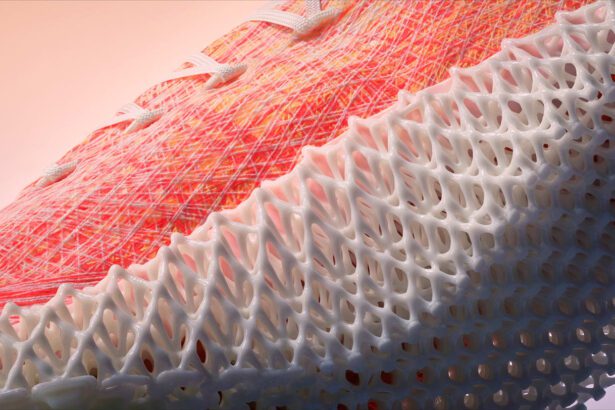


TPM3D has published new testing data for SLS 3D printed footwear, reporting that structures produced through its selective laser sintering and foaming process completed 200,000 dynamic bending cycles without collapse or fracture. Can that level of fatigue resistance help move 3D printed shoe components toward more demanding production applications?
TPM3D Combines SLS Printing With Material Foaming
The latest results come from TPM3D’s footwear work presented at Formnext Asia Shenzhen 2026, where the company outlined a manufacturing process combining selective laser sintering with material foaming.
Rather than relying on lattice geometry alone, TPM3D combines digital lattice design, SLS production, material processing and post-processing. The goal is to balance weight, cushioning, energy return and resistance to repeated deformation.
Increasing material volume can strengthen a component but also make it heavier. A softer lattice can reduce weight and improve cushioning while sacrificing rebound or long-term fatigue resistance.
TPM3D’s process attempts to control both geometry and material properties.
After SLS production, a foaming stage changes the material’s internal structure while retaining the designed external geometry. TPM3D reports a foaming ratio of up to 2.5 times, material density reaching 0.3 g/cm³ and apparent density as low as 0.1 g/cm³ under its disclosed processing conditions.

SLS 3D Printed Footwear Reaches 200,000 Bending Cycles
The most significant figure in TPM3D’s new data is the dynamic bending result.
According to the company, a third-party test subjected structures produced through its SLS and foaming process to 200,000 bending cycles. The tested samples showed no collapse or fracture after completing the test.
TPM3D also reported:
- Compression deformation of 22–26%
- Energy return of more than 70%
- 200,000 dynamic bending cycles without structural collapse or fracture
The figures provide more useful information than simply demonstrating that a complex shoe geometry can be printed. Repeated deformation is central to footwear performance.
A shoe sole is continuously flexed, compressed and unloaded during walking or running. A lattice that performs well initially becomes less useful if its structure deteriorates quickly under repeated loads.
The test therefore provides a useful reference point for 3D printed footwear durability, but it does not establish the lifespan of a finished shoe.
TPM3D notes that complete footwear durability still depends on product design, material formulation, manufacturing parameters and conditions of use. Finished footwear would require additional testing before these laboratory results could support claims about steps, mileage or service life.
Zoned Lattices Give 3D Printed Shoe Soles Different Properties
Selective laser sintering also changes what manufacturers can control inside a printed sole.
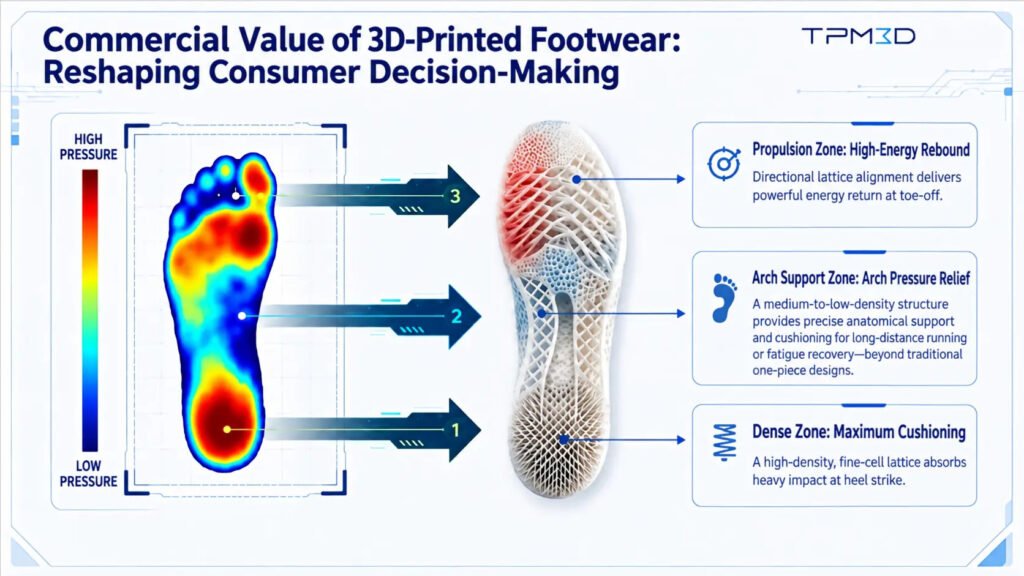
SLS can produce complex three-dimensional structures without the conventional support structures required by some additive processes. Designers can therefore vary lattice density, orientation and geometry across different regions of the same component.
A 3D printed shoe sole does not need one uniform lattice from heel to toe.
TPM3D describes an approach where different regions can be tuned for different functions. The heel could use a denser structure for load management, while the arch uses another geometry to balance support and flexibility. The forefoot can incorporate directional structures intended to influence deformation and energy return.
The practical advantage is that mechanical behavior can increasingly be adjusted through digital design rather than requiring a new physical mold for every structural change.
That does not remove the need for material testing. Changes in lattice geometry can also change the behavior of the finished component.
The same principle could extend beyond midsoles to structural supports, lasts and selected outsole elements where suitable materials are available.
SLS Footwear Manufacturing Moves Toward Batch Production
Durability is only part of the commercialization challenge. SLS footwear manufacturing also needs practical production capacity.
TPM3D is positioning its industrial SLS systems around three-dimensional nesting, allowing components to occupy the available build volume instead of sitting on a single production plane.
The company says its larger P550DL system can accommodate as many as 190 shoe soles in one build, depending on component geometry and nesting configuration.
That capacity matters because additive manufacturing footwear has historically faced a throughput problem. Producing one complex component can be technically impressive while remaining too slow or expensive for meaningful commercial volume.
Three-dimensional nesting improves utilization, but it does not solve the entire cost equation.
Manufacturers still need to account for:
- Printing time
- Machine utilization
- Powder recycling
- Post-processing
- Labor
- Quality control
- Material costs
Batch production nevertheless shifts the question from whether footwear structures can be printed to how efficiently multiple usable components can be produced within one manufacturing cycle.
TPM3D has been developing this direction for several years. In 2025, the company introduced an end-to-end SLS footwear workflow combining scanning, design and printing. Its more recent work has increasingly focused on polymer performance and industrial production.
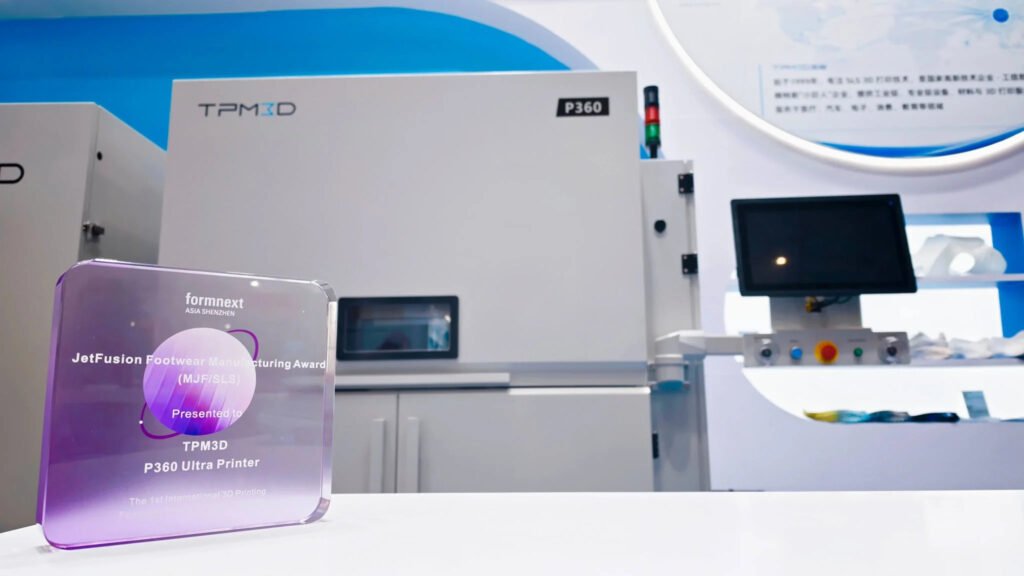
At Formnext Asia Shenzhen 2026, TPM3D’s P360 Ultra was also listed among the recipients of the JetFusion Footwear Manufacturing Award for MJF/SLS equipment at the inaugural International 3D Printed Footwear Design Awards.
What This Means for 3D Printed Footwear
The significance of TPM3D’s latest testing is not the 200,000-cycle figure alone. It reflects a wider shift toward evaluating printed footwear with engineering metrics that matter in manufacturing.
Early 3D printed footwear often demonstrated what additive manufacturing could create: complex lattices, seamless forms and geometries difficult to achieve with conventional tooling.
Commercial footwear requires different answers.
Manufacturers need to know whether structures retain their properties after repeated loading, whether components can be produced consistently and whether production remains economically viable at useful volumes.
TPM3D’s combination of lattice control, material foaming and SLS batch production addresses several of those issues within one manufacturing workflow.
That matters because footwear performance rarely depends on one property.
A lightweight sole offers limited value if rebound deteriorates rapidly. A highly resilient structure becomes less attractive if it requires excessive material. A strong prototype has limited commercial relevance if production throughput remains too low.
The opportunity for 3D printed shoe manufacturing is therefore optimization across several variables rather than maximizing one performance metric.
Digital manufacturing also enables structural adjustments without creating a new mold for every design iteration. Engineers can modify lattice density, orientation or internal geometry in software.
The practical limitation is that each meaningful change can alter component performance. Digital flexibility reduces tooling dependency, but it does not eliminate physical validation.
The Reality Check
TPM3D’s test does not establish that SLS footwear has solved durability.
The results describe specific structures produced using a defined process. They do not demonstrate that a complete shoe will retain the same performance over months of walking, running, temperature changes, moisture, abrasion and different user loads.
The published data also does not provide a complete cost comparison showing that SLS production is cheaper than conventional molded footwear at mass-market scale.
A manufacturing process can be technically viable without being economically suitable for every footwear category.
Powder handling, finishing, dimensional consistency, quality control and integration with other footwear components also remain part of the production equation.
The results should therefore be viewed as evidence of progress in structural fatigue resistance and manufacturing capability, not proof that additive manufacturing can broadly replace conventional footwear production.
What to Watch Next
The next meaningful development will be whether component-level testing progresses into complete footwear validation.
That includes tests that more closely reproduce actual use, such as repeated gait loading, abrasion, temperature variation and long-duration compression.
Production economics will be equally important. If industrial SLS systems can pack large numbers of shoe components into a build, the next useful figures will involve cycle time, material utilization, post-processing requirements and cost per finished component.
Material development is another area to watch. TPM3D has previously discussed PEBA and other elastomeric materials for performance footwear, pointing toward further work on the interaction between polymer chemistry and lattice geometry.
For SLS 3D printed footwear, the central question is no longer simply whether complex soles can be manufactured.
The next test is whether those structures can deliver repeatable performance, withstand prolonged use and reach production volumes and costs suitable for real footwear programs.
Mini FAQ
What is SLS 3D printed footwear?
SLS 3D printed footwear uses selective laser sintering to fuse powdered material into components such as midsoles or soles. The process can produce complex lattices without conventional support structures.
How durable is SLS 3D printed footwear?
TPM3D reports that specific SLS-and-foamed structures completed 200,000 dynamic bending cycles without collapse or fracture. That result does not establish the lifespan of a complete shoe.
Can SLS manufacture 3D printed shoes at scale?
Industrial SLS systems can batch multiple components in one build. TPM3D says its P550DL can accommodate up to 190 shoe soles depending on their geometry and nesting configuration.


