

I. When Buildings and Shoes Share the Same Problem
A house wall and a shoe sole are rarely mentioned in the same sentence—yet they solve remarkably similar material problems. Both must absorb impact, regulate temperature and moisture, remain lightweight, and endure repeated stress. Increasingly, both must also do this under intense scrutiny for their environmental cost.
This unlikely connection becomes clear when examining Itaca, the self-sufficient 3D‑printed housing prototype developed by WASP in Italy. At the heart of Itaca’s innovation is bio-based insulation made from rice husks and lime—an agricultural waste transformed into a high‑performance building material. What makes this relevant beyond architecture is not the scale, but the logic: if agricultural waste can insulate, stabilize, and protect a building, it can fundamentally reshape how we design shoes.
In this article, you’ll learn:
- What bio-based insulation really is and why it matters beyond construction
- Why rice husks are emerging as a serious material resource
- How Itaca’s rice‑husk bio‑infill translates directly to sustainable materials for shoes, particularly midsoles and outsoles
For footwear designers and brands searching for credible alternatives to petroleum foams, the lesson is clear: the future of shoes may already be standing—quietly—inside the walls of sustainable buildings.
II. What Is Bio-Based Insulation? (And Why Designers Should Care)
Bio-based insulation refers to insulating materials derived from renewable biological sources rather than fossil‑fuel‑based or mineral‑intensive inputs. In architecture, these materials are gaining traction as construction shifts away from cement‑heavy systems toward low‑carbon materials.
Common bio‑based insulators include:
- Rice husks (an agricultural byproduct)
- Hempcrete (hemp shiv combined with lime)
- Cork
- Mycelium‑based composites
What unites these materials is not sustainability marketing, but measurable performance:
- Thermal resistance enabled by porous microstructures
- Breathability that allows moisture transfer without heat trapping
- Low embodied carbon compared to cement or synthetic foams
Construction began moving away from cement because of its massive carbon footprint and rigid material logic. Footwear faces an almost identical challenge. Traditional midsoles—typically EVA or PU—are petroleum‑derived, energy‑intensive, difficult to recycle, and prone to long‑term degradation. Just as architecture is rethinking insulation, footwear must rethink cushioning.
This shift becomes even more urgent in the context of additive manufacturing sustainability: printing new forms at scale only makes sense if the materials themselves align with low‑carbon design goals.

III. Inside Itaca’s Rice Husk + Lime Infill System
WASP selected rice husks for Itaca for reasons that are both practical and philosophical.
Why rice husks?
- They are an abundant agricultural waste stream
- They are renewable and widely available, particularly in Asia and Southern Europe
- They are naturally lightweight, fibrous, and porous
In Itaca, rice husks are mixed with lime and used as infill inside thick, 3D‑printed structural walls. Lime functions as a stabilizer and binder, while the rice husks provide volume, insulation, and breathability.
Functional benefits include:
- Thermal insulation without synthetic foams
- Moisture regulation that reduces mold and heat buildup
- Carbon sequestration, as lime absorbs CO₂ during curing
Most striking is the environmental impact. The system uses zero cement, and lifecycle assessments indicate the wall assembly can achieve net‑negative carbon performance. Waste is not minimized—it is redefined as a structural asset.
For footwear designers, this is a critical insight: performance does not require material purity. It requires intelligent composition.
IV. Material Properties That Translate Directly to Footwear
The leap from walls to soles becomes obvious when material requirements are mapped side by side.
Architectural properties → Footwear equivalents
- Lightweight structure → midsoles and cushioning systems
- Porosity and breathability → moisture‑regulating insoles
- Shock absorption → impact dispersion in outsoles
- Low embodied energy → lower‑carbon footwear
Shoes, like buildings, are:
- Load‑bearing (supporting body weight and repeated impact)
- Comfort‑dependent (requiring thermal and mechanical regulation)
- Long‑wear products with extremely high material turnover
The difference is scale—not function. A midsole is essentially a compact structural system reproduced millions of times each year, making footwear an ideal testing ground for bio‑based material innovation.
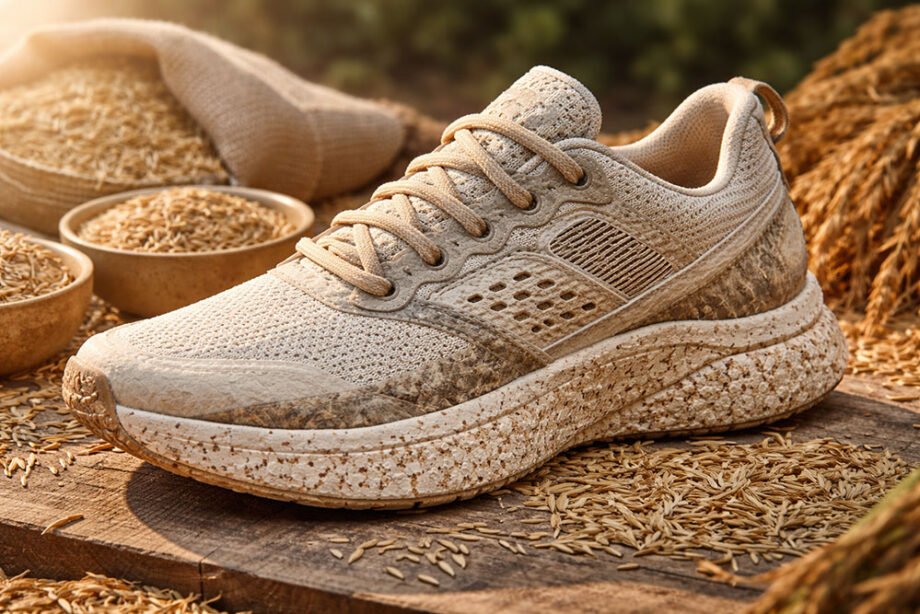
V. From Bio‑Infill to Bio‑Composite: Designing Rice‑Husk‑Based Soles
Translating rice husks into footwear does not mean copying architectural formulas. Instead, it means adapting the logic into bio‑composite footwear systems.
How rice husks can be used in shoes:
- Ground fillers in bio‑polymers to reduce virgin plastic content
- Reinforcement fibers to increase stiffness and resilience
- Foam‑like composites with tunable density
Potential applications include:
- Midsoles for cushioning and energy absorption
- Insoles for breathability and moisture management
- Structural lattice cores in 3D‑printed shoes
From a production standpoint, rice‑husk composites align well with additive manufacturing workflows:
- Pellet extrusion for midsole components
- Binder‑based systems for experimental lattice structures
- Hybrid constructions combining printed shells with bio‑foam cores
Rice husk composites already exist in decking, furniture, and automotive panels. Their adoption in footwear is less a technical barrier than a design decision.
VI. Performance vs. Sustainability: The Trade‑Offs Designers Must Solve
Sustainable footwear design requires honesty. Bio‑based materials present real challenges:
- Durability relative to petroleum foams
- Water sensitivity in untreated natural fibers
- Compression fatigue over extended wear cycles
Itaca addresses these limitations architecturally through lime stabilization, thick layered assemblies, and hybrid material logic. Footwear equivalents are already emerging:
- Bio‑resins that seal and protect fibers
- Surface coatings for abrasion resistance
- Hybrid constructions pairing bio‑cores with durable outer skins
The goal is not perfection—it is measurable improvement. Lower carbon impact, reduced virgin plastic, and better end‑of‑life outcomes are meaningful gains. In this sense, Itaca offers not a blueprint, but a permission structure to experiment.
VII. Circular Design Lessons: Turning Waste Into Value
In many regions, rice husks are burned or discarded. In Itaca, they become insulation. This is circular design in practice: redefining waste as value.
Footwear parallels are immediate:
- Agricultural waste fillers in midsoles
- Food‑industry byproducts in composites
- Local sourcing to reduce transportation emissions
Circular strategies inspired by Itaca include:
- Local production using regional waste streams
- Material transparency instead of greenwashed claims
- Design for recyclability or controlled biodegradation
Circular materials matter because they address systems, not slogans. Sustainability is not an aesthetic choice—it is an infrastructure decision.
VIII. What Shoe Brands and Designers Can Do Next
For brands exploring sustainable materials for shoes, the path forward is practical and incremental.
Start small:
- Test rice‑husk composites in insoles or fillers
- Avoid performance‑critical components initially
Build partnerships:
- Agricultural processors
- Bio‑material startups
- Research institutions
Prototype intentionally:
- Use bio‑fillers to reduce plastic content
- Explore hybrid printed structures
Measure what matters:
- Carbon reduction per pair
- Material efficiency
- End‑of‑life scenarios
The first step toward rice‑husk‑based footwear is not a perfect shoe—it is a better one.
IX. Architecture as a Blueprint for Footwear Innovation
Itaca demonstrates that radical sustainability can meet certification standards, performance requirements, and real‑world use. Its broader lesson is cultural: innovation accelerates when designers look beyond industry silos.
Footwear should look beyond fashion and into architecture because shoes are not accessories—they are micro‑architecture. They are wearable infrastructure that mediates between the human body and the environment.
The final takeaway: the future of shoes may be built the same way we now build the most sustainable homes—layer by layer, locally sourced, bio‑based, and circular by design.
If you’re a designer, brand, or innovator exploring bio‑based insulation principles, sustainable midsole materials, or next‑generation bio‑composite footwear, now is the moment to move beyond convention.
- Explore more insights on sustainable footwear innovation on 3DSHOES.com
- Share this article with material scientists, designers, and sustainability leaders
- Start asking a better question: What if your next shoe was designed like a building meant to last?
Sources & Further Reading
🏠 About the Itaca Project — 3D-Printed Self-Sufficient Housing
- Itaca: A Self-Sufficient 3D-Printed Housing Model by WASP — in-depth overview of the design, materials (lime + rice husk infill), construction process, and sustainability strategy. Itaca: A Self‑Sufficient 3D‑Printed Housing Model by WASP
- Itaca: Circular & Self-Sufficient Architecture (MaterialDistrict) — technical focus on 3D printing with lime and rice husk biobased insulation. Itaca: Circular and Self‑Sufficient Architecture
- Designboom feature on Itaca’s geometry & self-sufficiency — coverage of mandala layout, off-grid systems, and landscape integration. Self‑Sufficient 3D Printed Farm Finishes in Italy (Designboom)
- Itaca project page on Archilovers — architectural brief highlighting lime mix and rice husk internal insulation. Itaca | WASP (Archilovers)
- Shamballa research campus context — sustainable living lab where Itaca is being built. WASP builds sustainable 3D printing center in Shamballa
🌱 Bio-Based Materials & Rice Husk Composites
- A comprehensive review of hybrid rice husk polymer resin biocomposites (2025) — open access research on rice husk reinforcement in polymer composites (mechanical & thermal implications useful for footwear materials). Performance Enhancement of Rice Husk Polymer Biocomposites (Springer)
- Rice husk polymer composite biodegradability & properties (MDPI) — study on rice husk used with biodegradable polymers, relevant for assessing sustainable footwear composites. Rice Husk‑Filled Polymer Composites Overview (MDPI)
- Rice husk composites for lightweight and insulating materials (ScienceDirect) — research on rice husk in construction composites, underlining thermal performance parallels. Sustainable Thermal Biocomposites from Rice Husk
- Review of rice husk bio-based composites (Bentham Science) — foundational review on rice husk as renewable filler for green composite materials. Review of Rice Husk Bio‑Based Composites
🌍 Related Sustainability & Circular Design Context
- 3D Printing Industry on WASP’s Shamballa sustainable lab — broader context of how additive manufacturing and ecology are integrated at the project site. WASP Unveils Shamballa Open‑Air 3D Printing Lab