
Why Shoe Fit Is Broken — and Why Fitasy Stride Is Arriving at the Perfect Time
For decades, footwear innovation has focused on materials, cushioning, and aesthetics. Yet one fundamental problem has remained largely untouched: fit. Despite advances in technology across nearly every consumer category, most shoes are still mass-produced using standardized sizing systems that fail to account for real human foot variation.
Fitasy Stride aims to change that. Developed by Indianapolis-based startup Fitasy, Stride is a fully custom 3D printed shoe designed from a precise digital scan of each customer’s feet. More importantly, Fitasy claims it has solved the hardest part of customization: making it affordable. At $195 per pair, Stride positions itself as one of the first examples of affordable 3D printed footwear built for everyday consumers rather than niche medical or luxury markets.
This article explains how Fitasy Stride works, why custom shoes have historically been expensive, and why this launch could mark a turning point for the footwear industry — not just for sneaker fans, but for the future of how shoes are made.
What Is Fitasy Stride and Why Are People Paying Attention?
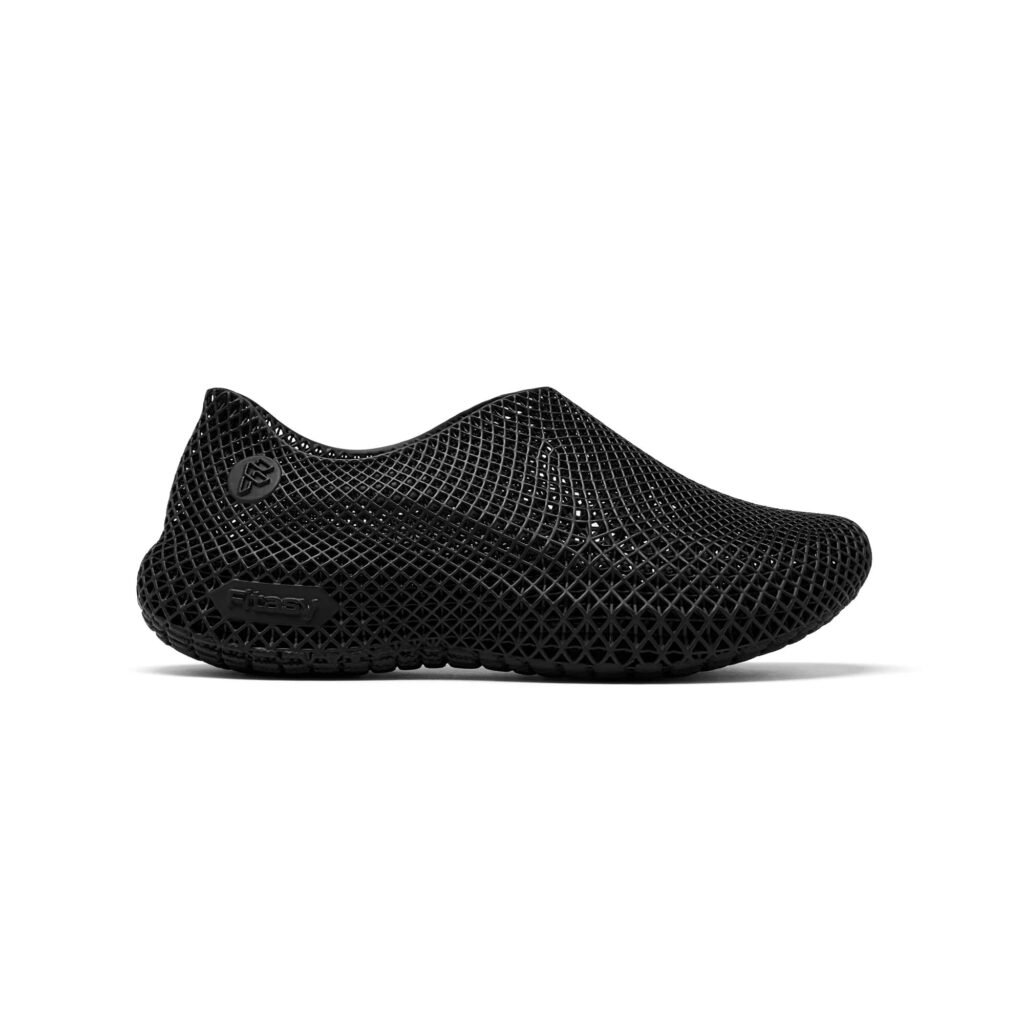
Fitasy Stride is a fully 3D-printed sneaker created specifically for each wearer’s foot geometry. Unlike traditional shoes produced in standard sizes and widths, every pair of Stride shoes is digitally designed and printed on demand.
Key details:
- Company: Fitasy (Indianapolis, USA)
- Product: Stride
- Price: $195 per pair
- Colors: Black or white
- Launch: Debuting at CES, shipping planned for Spring 2026
- Use case: Daily wear and recovery
Stride is printed as a single, seamless piece using recyclable polyurethane and features a proprietary triple-layer lattice structure engineered for comfort, airflow, and shock absorption.

Why Custom Shoes Have Always Been Expensive — Until Now
Custom footwear has existed for decades, but it has never been accessible to most consumers.
Traditional bespoke or orthopedic shoes typically require:
- In-person fittings
- Manual measurements or plaster casts
- Skilled labor and craftsmanship
- Multiple production iterations
As a result, prices often range from $1,000 to $5,000 or more. These methods are not scalable and rely heavily on human labor.
Mass-produced footwear dominates because it scales cheaply, even though it leads to poor fit for many users and high return rates. Industry data shows that roughly 30% of online shoe purchases are returned, creating massive waste and inefficiency.
Fitasy’s approach targets these structural problems directly.
How Fitasy’s Scan-to-Print Technology Works (No Store Visit Required)
Fitasy replaces manual fitting and physical molds with a smartphone-based digital workflow.
Step-by-step process
- Smartphone foot scan capturing both weight-bearing and relaxed positions
- Spatial AI generates a personalized digital fit profile
- AI-driven software designs a shoe geometry unique to each foot
- On-demand 3D printing at regional partner facilities
- Direct-to-consumer delivery with no inventory or size guessing
This scan-to-print model eliminates the need for specialized scanning hardware or retail visits, dramatically lowering the barrier to custom footwear.
Inside the Technology Behind Fitasy Stride
Triple-Layer Lattice Sole
At the core of Stride is a triple-layer lattice structure that allows different zones of the shoe to respond dynamically to pressure and movement.
Benefits include:
- Enhanced shock absorption
- Reduced pressure points
- Improved joint impact reduction
- Adaptive support based on individual foot anatomy
Lattice-based designs have been widely recognized in 3D printing for delivering superior energy return and durability when compared to traditional foam.
Single-Material, One-Piece Construction
Stride is printed as a single unit, including the sole, midsole, upper, and tread. All components are made from the same recyclable polyurethane material.
This approach eliminates glue, stitching, and mixed materials, resulting in a shoe that is easier to recycle and more consistent in performance.
Why Fitasy Stride Is Considered Truly Affordable
The $195 price point is central to Fitasy’s value proposition.
Cost efficiencies come from:
- No physical inventory
- No unsold sizes
- Automated AI-driven design
- On-demand production
- Reduced return rates
- Simplified material sourcing
Compared to traditional custom footwear, Stride costs a fraction of the price. Compared to premium mass-market sneakers, it remains competitively priced while offering full customization.
Fitasy states that its production model can reduce material waste and scrap by up to 70 percent.
Why Fitasy Matters Right Now
The timing of Fitasy’s launch aligns with major industry trends.
The global 3D printed footwear market was valued at approximately $1.6 billion in 2023 and is projected to reach $5.4 billion by 2030. Growth is driven by consumer demand for personalization, sustainability, and digital-first shopping experiences.
Millennials and Gen Z consumers, in particular, show a strong preference for customized and environmentally responsible products, positioning Fitasy well within these shifts.
Fitasy vs Other 3D-Printed Shoe Brands
Fitasy operates within a growing ecosystem of 3D printed footwear, but its approach differs in key ways.
Fitasy offers fully custom, entire-shoe printing at a consumer-accessible price. Competitors like Zellerfeld also pursue full customization but at higher price points. Large brands such as Adidas have experimented with 3D printing through products like Futurecraft 4D, though typically limited to midsoles rather than full shoes.
Other startups such as Wiivv and Hilos focus on partial customization or specific components like insoles. Fitasy’s combination of full customization, competitive pricing, and smartphone accessibility distinguishes it within the market.
Why Fitasy’s Sustainability Model Stands Out
Footwear is notoriously difficult to recycle due to its use of mixed materials and adhesives. Fitasy’s single-material design addresses this issue directly.
Sustainability benefits include:
- On-demand production
- No excess inventory
- Reduced landfill waste
- Single-material recyclability
- Potential closed-loop recycling systems
As sustainability becomes a key purchasing factor, this approach could become a significant competitive advantage.
What the Industry Is Saying About Fitasy Stride
Industry response to Fitasy Stride has been cautiously optimistic. Technology publications have highlighted the comfort potential of lattice-based soles, while sports technology organizations describe Fitasy’s scan-to-print model as a paradigm shift in footwear manufacturing.
Fitasy plans to debut Stride at CES, generating anticipation among footwear, manufacturing, and consumer technology professionals. Consumer reviews are not yet available due to the 2026 shipping timeline, but early interest has been strong.
The Big Questions Fitasy Still Has to Answer
Despite its promise, Fitasy faces several challenges:
- Long-term durability under daily use
- Performance compared to traditional foam-based shoes
- Scaling production globally
- Building consumer trust in fully digital sizing
How Fitasy addresses these questions will determine its long-term success.
Final Verdict: Are Custom 3D-Printed Shoes Finally Ready for Everyone?
Fitasy Stride represents a meaningful shift in how shoes can be designed, produced, and sold. By combining smartphone scanning, AI-driven customization, and on-demand 3D printing, Fitasy has removed many of the cost and scalability barriers that have historically limited custom footwear.
At $195, Stride challenges the assumption that personalization must be expensive. If the product delivers on comfort, durability, and fit, Fitasy could help redefine footwear sizing altogether.
Custom 3D printed shoes may finally be moving from experimental novelty to mainstream reality.
Sources
- Fitasy Official Website: https://fitasy.com
- Yahoo Finance Coverage: https://finance.yahoo.com/news/fitasy-unveils-breakthrough-technology-making-090000089.html