
3D Shoes 3D Shoes
  • News
  • Innovation
  • Design
  • Companies
  • Shoes
Reading: Advancing 3D Printing: A Scalable Method for Recyclable, High-Performance Soft Plastics
Follow 3DShoes on LinkedIn
Font ResizerAa
3DShoes3DShoes
  • Home
  • About
  • Directory
  • Shoes
  • Innovation
  • Design
  • News
  • Shoes
Anouk Wipprecht designer | engineer | educator | public speaker

5 Must-See Videos That Prove 3D Printing Is Revolutionizing Fashion and More!

R_Shoes R_Shoes January 22, 2025
5.9kLike
4kFollow
3.7kPin
3.7kFollow
  • 3D Printed Shoes
  • 3D Companies
  • About
  • STL Files
  • Contact
© 2026 3DShoes.com. All Rights Reserved.
Innovation & Trends

Advancing 3D Printing: A Scalable Method for Recyclable, High-Performance Soft Plastics

R_Shoes
Last updated: March 1, 2025 10:00 am
By R_Shoes 6 Min Read
Share
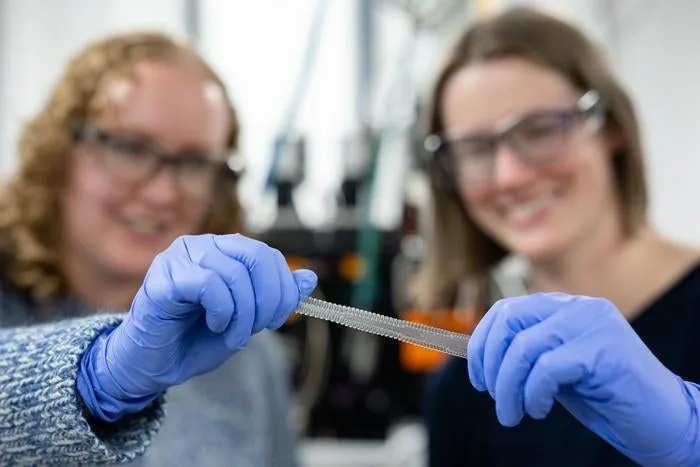
By controlling the material's internal structure, engineers can create objects with a range of properties. (CREDIT: Sameer A. Khan/Fotobuddy)
SHARE

Researchers at Princeton University have developed an innovative 3D printing technique that facilitates the production of highly customizable, recyclable soft plastics. This advancement, detailed in Advanced Functional Materials, presents a paradigm shift in material engineering, offering a sustainable and cost-effective alternative applicable across numerous industries, including soft robotics, medical devices, and high-performance sports equipment.

Table of Contents
Biomimetic Design and Engineering PrecisionMolecular Engineering and Material BehaviorEnhancing Performance Through Thermal AnnealingEconomic and Environmental Superiority Over Existing MaterialsBroad Implications for Advanced ManufacturingFuture Research Directions

Biomimetic Design and Engineering Precision

In nature, materials derive exceptional properties from intricate hierarchical structures. The durability of nacre, the structural resilience of bamboo, and the iridescence of butterfly wings exemplify the influence of molecular architecture on function. Historically, synthetic materials have struggled to replicate this level of sophistication; however, advancements in high operating temperature direct ink writing (HOT-DIW) are now enabling a comparable level of control in engineered materials.

Princeton’s research team harnessed HOT-DIW to fabricate thermoplastic elastomers (TPEs), a class of nanostructured polymers known for their tunable mechanical properties. As explained by Emily Davidson, assistant professor of chemical and biological engineering, this methodology allows for the precise customization of materials in multiple orientations.

“We can create materials that have tailored properties in different directions,” Davidson stated, underscoring the potential applications of this technology in fields requiring both flexibility and structural integrity.
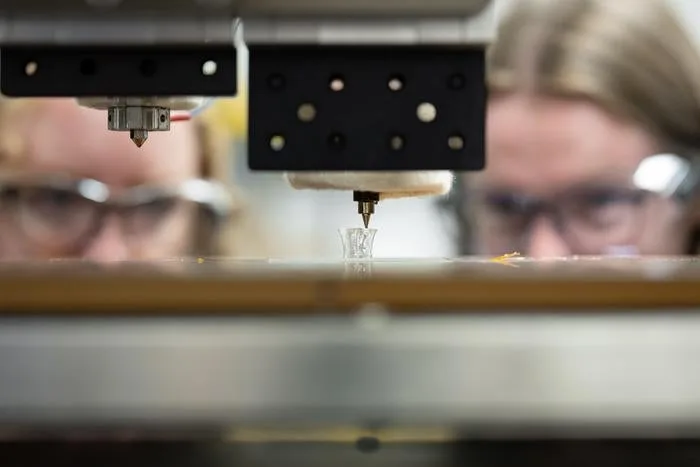
Discover how a novel 3D printing method enables recyclable, affordable soft plastics with tailored properties, promising advancements in robotics and healthcare. (CREDIT: Sameer A. Khan/Fotobuddy)

Molecular Engineering and Material Behavior

At the core of this breakthrough lies the molecular architecture of TPEs. These block copolymers feature rigid cylindrical nanostructures embedded in a flexible polymer matrix. The alignment of these nanocylinders, which measure 5-7 nanometers in thickness, during the printing process imparts exceptional mechanical anisotropy, enabling precise control over material properties.

To achieve this alignment, the research team employed controlled shear and extensional flows during HOT-DIW printing. By refining printing parameters, they achieved up to an 85-fold variation in tensile modulus between different orientations of the material—an unprecedented level of mechanical tunability in soft plastics.

Enhancing Performance Through Thermal Annealing

A crucial aspect of this technique is thermal annealing, a controlled heating and cooling process that significantly enhances material performance. Lead researcher and graduate student Alice Fergerson highlighted its dual functionality: “It drastically improves the properties after printing and allows the printed structures to be reused multiple times. It even enables self-healing when damaged.”

Annealing optimizes the nanostructural alignment, resulting in enhanced mechanical properties. Moreover, the self-healing capability of the printed material was demonstrated when a severed sample was seamlessly rejoined through heat treatment, restoring its original mechanical integrity without degradation.
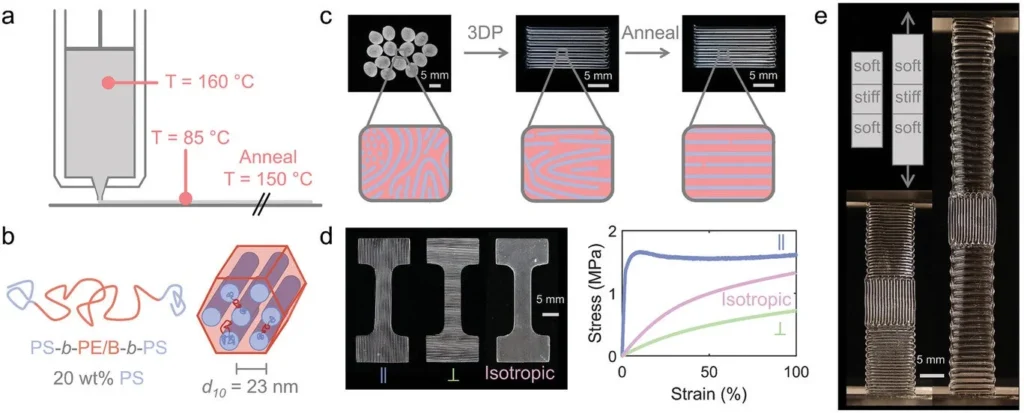
3D printing-induced alignment of TPE triblock copolymers. (CREDIT: Advanced Functional Materials)

Economic and Environmental Superiority Over Existing Materials

A distinguishing advantage of this approach is its cost efficiency. Traditional liquid crystal elastomers (LCEs), which offer tunable mechanical properties, are cost-prohibitive at approximately $2.50 per gram and necessitate complex, multi-stage processing. In contrast, TPEs cost $0.01 per gram and are compatible with widely available commercial 3D printers, significantly lowering the barrier for industrial-scale implementation.

Beyond cost-effectiveness, TPEs’ recyclability offers a compelling environmental benefit. Unlike chemically cross-linked elastomers, TPEs can be reprocessed via melting without material degradation. Additionally, the research team successfully integrated functional additives—such as an organic molecule that causes the plastic to fluoresce under ultraviolet light—demonstrating the material’s potential for applications in wearables, sensors, and smart materials.

Broad Implications for Advanced Manufacturing

The implications of this research extend across multiple disciplines. In soft robotics, materials exhibiting both flexibility and durability could facilitate the development of more responsive and adaptive robotic systems. Similarly, customized medical devices and prosthetics could be tailored with greater precision to meet individual patient needs. Furthermore, high-performance sports equipment, such as helmets and footwear, could be engineered for superior shock absorption and wear resistance.

To showcase the precision of their 3D printing process, the Princeton team fabricated intricate structures, including a miniature plastic vase and the word “Princeton” rendered in a complex, sharply defined design. These examples underscore the technique’s ability to produce geometrically sophisticated and mechanically robust materials.

Future Research Directions

The researchers aim to further refine this technology by developing new printable architectures optimized for wearable electronics and biomedical applications. Additional studies will explore the integration of conductive and sensing materials, expanding the functional capabilities of TPE-based structures.

By leveraging fundamental insights into polymer physics alongside advanced manufacturing techniques, the Princeton team has successfully created a scalable, cost-effective, and sustainable material solution. As industries increasingly prioritize sustainability and efficiency, innovations such as this could redefine material design and manufacturing standards.

With its capacity to produce durable, recyclable, and precision-engineered soft plastics, this technological breakthrough holds immense promise for revolutionizing multiple sectors, including healthcare, robotics, and consumer goods.

Sources:

  • Princeton University Research
  • Advanced Functional Materials
  • The Brighter Side of News (Content adapted for style and clarity)

VIA:Joshua Shavit
Share This Article
Facebook Twitter Pinterest Whatsapp Whatsapp LinkedIn Reddit Telegram Email Copy Link Print

Launching something like this?

If you're working on a product, platform, or business, I design fast, SEO-structured WordPress websites built for real results..

Start Your Project
100+ websites built • 15+ years experience

Stay Up To Date!

Sign up for 3DShoes.com's mailing list where you will stay up-to-date with latest trends, drops, and more.

loader

Website Help

Need a website for your project?

I build clean, fast, SEO-structured WordPress websites for real business results.

Start Your Project
100+ websites built • 15+ years experience

Trending

Top 10 best 3D-printed shoes of 2025 featuring futuristic lattice-sole sneakers for performance and lifestyle wear
Top 10 Best 3D-Printed Shoes of 2025 — Performance, Fashion & Value
December 27, 2025
Syntilay Pulse Podz
PulsePodz Review — Is Syntilay’s 3D-Printed Recovery Slide Worth $149?
January 19, 2026
A close-up of a modern 3D printer creating a small figurine, representing digital manufacturing and copyright issues.
3D Printing and Copyright: When Does Making a Replica Become a Crime?
November 9, 2025
Skylrk Earth Bender shoe. Courtesy
Justin Bieber x Zellerfeld Reveal the Earth Bender — A 3D-Printed, Soccer-Inspired Shoe for SKYLRK
December 6, 2025

3D Printed Shoes →

3D Printing Companies →

Topics

  • Innovation
  • Design
  • News
  • Guides
  • Products
Follow 3DShoes on LinkedIn

Affiliate links on 3DShoes may earn us a commission. Learn more.

News

How Formism and Bambu Lab Are Rewriting Footwear: Inside the Persona 3D-Printable Shoe Launch

FORMISM by SCRY

Introduction — downloadable shoes, at last A small but significant shift in how we obtain footwear has moved from concept to market. FORMISM — a digital production studio created by…

January 21, 2026 News

Your may also like!

Innovation & Trends

Best 3D Printing Service in 2026

R_Shoes April 10, 2026
Nike Air Works
News

Inside Nike Air Works: The 3D-Printed Air Max Program Explained

R_Shoes April 10, 2026
adidas Project R.A.P 3D-printed performance footwear concept
News

What Is adidas Project R.A.P? The Future of 3D-Printed Performance Footwear Explained

R_Shoes March 25, 2026
Image to 3D print workflow using Meshy and MakerWorld showing image conversion to 3D model and final printed object
News

Image to 3D Print Workflow Explained: What Meshy + MakerWorld Makes Possible

R_Shoes March 21, 2026

NEWSLETTER

Stay Updated on 3D Footwear Innovation

Get the latest insights, breakthroughs, and industry updates delivered to your inbox.

loader

No spam. Just relevant industry updates.

3D Shoes

3DShoes tracks the evolution of 3D-printed footwear—covering design, technology, and manufacturing to help make sense of where the industry is heading.

Quick Links

  • 3D Printed Shoes
  • 3D Companies
  • About
  • STL Files
  • Contact

Legal

  • Privacy Policy
  • Cookie Policy (EU)
  • Disclaimer
  • Terms & Conditions

Socials

Our website stores cookies on your computer. They allow us to remember you and help personalize your experience with our site. Read our privacy policy for more information.

© 2026 3DShoes – All Rights Reserved. Hosted & Developed by PixelCrafted.Dev.

Manage Consent
To provide the best experiences, we use technologies like cookies to store and/or access device information. Consenting to these technologies will allow us to process data such as browsing behavior or unique IDs on this site. Not consenting or withdrawing consent, may adversely affect certain features and functions.
Functional Always active
The technical storage or access is strictly necessary for the legitimate purpose of enabling the use of a specific service explicitly requested by the subscriber or user, or for the sole purpose of carrying out the transmission of a communication over an electronic communications network.
Preferences
The technical storage or access is necessary for the legitimate purpose of storing preferences that are not requested by the subscriber or user.
Statistics
The technical storage or access that is used exclusively for statistical purposes. The technical storage or access that is used exclusively for anonymous statistical purposes. Without a subpoena, voluntary compliance on the part of your Internet Service Provider, or additional records from a third party, information stored or retrieved for this purpose alone cannot usually be used to identify you.
Marketing
The technical storage or access is required to create user profiles to send advertising, or to track the user on a website or across several websites for similar marketing purposes.
  • Manage options
  • Manage services
  • Manage {vendor_count} vendors
  • Read more about these purposes
View preferences
  • {title}
  • {title}
  • {title}
Stay Up To Date!

Sign up for 3DShoes.com's mailing list where you will stay up-to-date with latest trends, drops, and more.

loader

Zero spam, Unsubscribe at any time.
adbanner
AdBlock Detected
Our site is an advertising supported site. Please whitelist to support our site.
Okay, I'll Whitelist
Welcome Back!

Sign in to your account

Lost your password?