

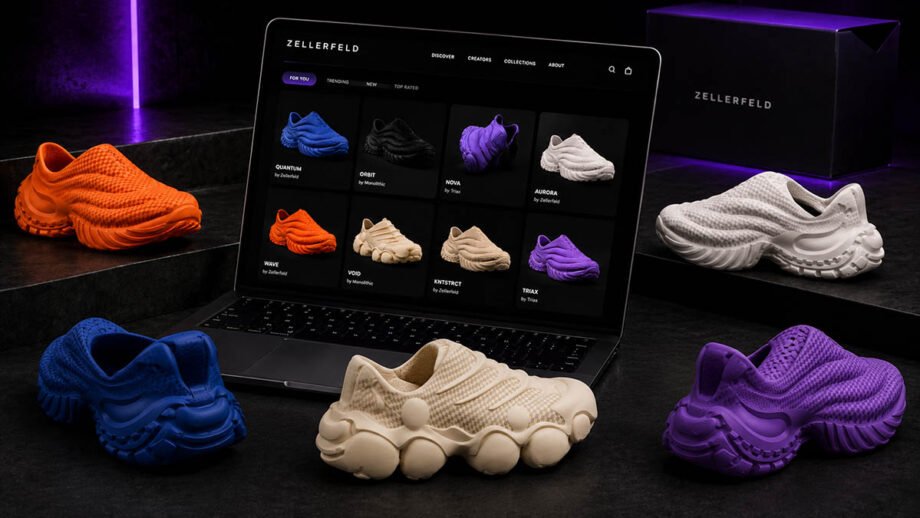
The 3D printed footwear marketplace is evolving beyond a simple online storefront as Zellerfeld unveils its most significant platform update since opening its manufacturing network to independent designers. Is this simply a website redesign, or does it signal the next phase of digital footwear commerce?
The company’s latest update introduces personalized product discovery, persistent digital fit profiles, creator rankings, and a subscription preview, signaling a strategic move from manufacturing custom shoes to operating a platform built around personalized, on-demand footwear.
Zellerfeld Transforms Its Marketplace Into a Digital Footwear Platform
The redesign is more than a visual refresh.
According to Zellerfeld, the platform now incorporates several new capabilities that fundamentally change how users discover and purchase footwear:
- Personalized product recommendations
- Intelligent search functionality
- Live creator rankings
- Persistent ZellerFIT profiles
- A preview of a subscription model
- Improved creator discovery
Instead of functioning solely as a catalog of available designs, the marketplace increasingly behaves like a content platform where designers gain visibility through demand and user engagement. This aligns with CEO Cornelius Schmitt’s long-term vision of digitizing footwear in the same way streaming platforms transformed music and video distribution.
How the 3D Printed Footwear Marketplace Delivers Personalized Fit
A major addition is the expansion of ZellerFIT, the company’s personalized fit system.
Rather than selecting a shoe size for every purchase, customers create a digital fit profile using a smartphone foot scan and personal fit preferences. That profile is then applied automatically to future orders across the marketplace.
The system aims to reduce one of online footwear’s biggest pain points:
- sizing uncertainty
- inconsistent fit between models
- return rates
- checkout hesitation
Unlike traditional e-commerce sizing tools that recommend an existing size, ZellerFIT becomes part of the manufacturing workflow, allowing every shoe to be produced specifically for the customer’s digital foot profile.
The Volumental Partnership Strengthens Manufacturing Precision
The marketplace relaunch follows Zellerfeld’s commercial partnership with Swedish foot-scanning company Volumental.
Rather than treating foot scanning as a retail convenience, the partnership integrates measurement data directly into Zellerfeld’s production pipeline.
According to both companies, the goal is manufacturing-grade accuracy rather than simple size recommendation.
The collaboration focuses on three requirements:
- highly accurate foot measurements
- reliable 3D foot models
- simple smartphone or in-store scanning
Cornelius Schmitt stated that Zellerfeld evaluated foot-scanning providers globally before selecting Volumental, emphasizing that accurate input data is essential when every shoe is manufactured individually rather than selected from standard inventory.
Creator Rankings Shift Discovery Toward a Platform Economy
One of the most notable additions is the introduction of live creator rankings.
Traditional footwear websites typically organize products by category, collection, or brand.
Unlike conventional e-commerce stores that rely primarily on product categories, Zellerfeld’s marketplace increasingly surfaces creators and products based on engagement and demand, making discovery a more dynamic experience.
Zellerfeld instead introduces demand-driven discovery, where creators and products gain visibility based on marketplace activity.
This approach resembles digital creator platforms more than conventional footwear retail.
Potential benefits include:
- greater exposure for independent designers
- easier product discovery
- dynamic merchandising
- continuous marketplace engagement
For creators, visibility becomes part of the product ecosystem rather than relying solely on external marketing.
While the company has described the experience as inspired by digital media platforms, its long-term success will depend on maintaining a diverse creator community and sustained consumer participation.
What This Means for 3D Printed Footwear
The marketplace relaunch reflects a broader evolution in digital manufacturing.
Until now, much of the conversation around 3D printed footwear has focused on printers, materials, and production methods. Zellerfeld’s latest update shifts attention toward the software layer that connects customers, creators, and manufacturing.
This matters because digital manufacturing depends on more than production capacity.
It also requires:
- accurate customer data
- efficient product discovery
- scalable creator participation
- seamless ordering workflows
The redesign suggests Zellerfeld is investing as heavily in its digital commerce infrastructure as it has in additive manufacturing.
That does not mean the traditional footwear model is being replaced overnight. Conventional manufacturing remains more cost-effective for high-volume standardized products, while Zellerfeld’s approach is currently best suited to customized, on-demand production.
Reality Check: What the Platform Still Doesn’t Solve
Although the marketplace introduces meaningful improvements, several practical challenges remain.
The redesign does not eliminate production lead times.
Every pair is still manufactured after an order is placed, meaning customers should not expect the immediate fulfillment associated with warehouse inventory.
The platform also depends on customer participation.
Accurate personalized production begins with an accurate foot scan. If scan quality is poor or user preferences are incomplete, the resulting fit may still require refinement.
Finally, creator rankings are new.
Their long-term effectiveness will depend on marketplace growth, active participation, and transparent ranking mechanisms rather than the redesign alone.
What to Watch Next
Several developments could determine whether this platform strategy succeeds over the next year.
Industry observers should watch for:
- rollout of the announced subscription program
- expansion of creator participation
- broader integration of Volumental scanning
- adoption of personalized fit profiles by repeat customers
- marketplace growth beyond footwear into additional product categories
CEO Cornelius Schmitt has already indicated that the company’s long-term ambition extends beyond shoes, suggesting the digital platform could eventually support other customizable consumer products if the footwear model proves successful.
Mini FAQ
What is ZellerFIT?
ZellerFIT is Zellerfeld’s personalized fit system that creates a digital foot profile from a smartphone scan and applies it across future footwear purchases, reducing sizing uncertainty.
Why did Zellerfeld redesign its marketplace?
The company redesigned its marketplace to improve creator discovery, personalize shopping, introduce persistent fit profiles, and support a broader digital platform strategy for on-demand footwear.
Does the new marketplace change how shoes are manufactured?
No. Shoes are still produced on demand using Zellerfeld’s additive manufacturing process. The update focuses on improving discovery, personalization, and the customer experience rather than changing the manufacturing method itself.