3D Shoes 3D Shoes
  • News
    NewsShow More
    FORMISM by SCRY
    How Formism and Bambu Lab Are Rewriting Footwear: Inside the Persona 3D-Printable Shoe Launch
    January 21, 2026
    Close-up of STARAY’s NEOHEX lattice sole technology from the CES 2026 showcase
    STARAY CES 2026 Reception — What Attendees Said, On-Site Sales & Award Wins
    January 14, 2026
    CES 2026
    CES 2026 3D Printing Roundup — AtomForm, Creality, Gauss MT90 & More
    January 9, 2026
    Skylrk Earth Bender shoe. Courtesy
    Justin Bieber x Zellerfeld Reveal the Earth Bender — A 3D-Printed, Soccer-Inspired Shoe for SKYLRK
    December 6, 2025
    Digital illustration of DJI’s drone technology advancing into the defense and battlefield industry, symbolizing investment growth and rising global demand for military-grade drones
    DJI vs. the Desktop Factory: How the World’s Drone King Quietly Bought a Stake in the 3D‑Printing Goldrush
    November 28, 2025
  • Design
    DesignShow More
    PollyFab Review
    The Ultimate Guide to PollyFab 3D-Printed Shoes (Aero & Flux) — Tech, Fit, and Real Reviews
    November 17, 2025
    A close-up of a modern 3D printer creating a small figurine, representing digital manufacturing and copyright issues.
    3D Printing and Copyright: When Does Making a Replica Become a Crime?
    November 9, 2025
    Nike A.I.R dragon-scale 3D-printed sprint spike prototype
    AI 3D Printing: How Smart Machines Are Reinventing Footwear—from Design to Delivery
    July 16, 2025
    adidas Is Dropping A Laced Version Of The Climacool
    Adidas Climacool Laced 2025 Release: What You Need to Know Before Buying
    June 20, 2025
    Side profile of the red 3-D-printed Nike Air Max 1000 prototype
    Nike Air Max 1000 vs Adidas 4DFWD 3: Can Either 3‑D‑Printed Sneaker Survive 500+ Miles?
    June 16, 2025
  • Trends
    TrendsShow More
    Stride - 3D Printed Sneaker
    Fitasy Stride vs Recovery Shoes — Which Is Better for Post-Run Recovery?
    January 31, 2026
    Syntilay Pulse Podz
    PulsePodz Review — Is Syntilay’s 3D-Printed Recovery Slide Worth $149?
    January 19, 2026
    Top 10 best 3D-printed shoes of 2025 featuring futuristic lattice-sole sneakers for performance and lifestyle wear
    Top 10 Best 3D-Printed Shoes of 2025 — Performance, Fashion & Value
    December 27, 2025
    EDDY by HEK LAB
    EDDY 3D printed shoe — Full breakdown of Hek Lab’s everyday 3D-printed sneaker
    December 17, 2025
    Daniel Asante Influencer @mr.dasante
    Fitasy Stride Explained: How Custom 3D-Printed Shoes Are Finally Becoming Affordable (And Why It Matters Now)
    December 13, 2025
  • Picks
    PicksShow More
    High-resolution collage featuring five popular running shoes — Nike Invincible 4, HOKA Bondi 9, ASICS GEL-Nimbus 27, New Balance FuelCell SC Elite v4, and Adidas 4DFWD — recommended for an EPU 45 midsole upgrade.
    5 Running Shoes That Need Carbon’s EPU 45 Foam (But Probably Won’t Get It Yet)
    June 10, 2025
    Anycubic Wash & Cure 3
    Budget vs. Premium: Which Wash & Cure Station Is Right for You in 2025?
    June 5, 2025
    CAD for kids course review covers a 16-week program taking learners from CAD sketch to 3D-printed model, summarizing projects, skills and required tools.
    CAD for Kids – Build, Create & Learn — Our Full Project-Based Review
    May 8, 2025
    Best Subscription Boxes for Moms This Mother’s Day (2025 Gift Guide)
    🎀 Best Subscription Boxes for Moms This Mother’s Day (2025 Gift Guide)
    April 29, 2025
    3D Printing from Zero to Hero in Blender – FDM & MSLA - Course Review
    3D Printing from Zero to Hero in Blender – FDM & MSLA: Build, Create & Learn — Our Full Project-Based Review
    April 12, 2025
  • Shoes
Reading: Smart Self-Powered 3D Printed Scaffolds Could Revolutionize Bone Defect Repair
Fuel Our Steps
Font ResizerAa
3DSHOES.COM3DSHOES.COM
  • News
  • Design
  • Recommended Picks
  • STL Files
Search
  • Home
  • News
  • Design
  • Recommended Picks
Self-Lacing Shoes Make The Future A Reality

Self-Lacing Shoes Make The Future A Reality

R_Shoes R_Shoes June 26, 2024
5.9kLike
4kFollow
3.7kPin
3.7kFollow
  • Home
  • About
  • STL Files
  • Contact
  • Shoes
© 2024 3DSHOES.com. All Rights Reserved.
Innovation & Trends

Smart Self-Powered 3D Printed Scaffolds Could Revolutionize Bone Defect Repair

Based on the research article: Li, B., Ma, Y., Fatima, K., Zhou, X., Gu, X., Chen, S., & He, C. (2025). 3D printed shape-memory piezoelectric scaffolds with in-situ self-power properties for bone defect repair. Journal of Nanobiotechnology, 23, Article 244. https://doi.org/10.1186/s12951-025-03325-x

R_Shoes
Last updated: March 25, 2025 6:10 am
By R_Shoes 9 Min Read
Share
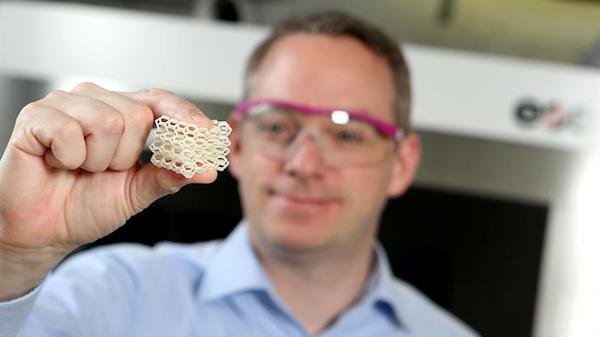
Medical visualization of a smart 3D-printed bone scaffold implant generating electricity and expanding inside a leg bone to aid healing.
SHARE

What If a Tiny Implant Could Power Itself and Help Your Bones Heal?

Picture this: a miniature implant that doesn’t just fill a gap in your bone—it actively helps it heal, using electricity it generates all by itself. No wires, no batteries, just smart science doing its job from inside your body. That’s not science fiction—it’s the future of bone repair. By combining cutting-edge 3D printing with materials that move and generate energy like living tissue, scientists are turning passive implants into active healing machines.

Table of Contents
What If a Tiny Implant Could Power Itself and Help Your Bones Heal?What the Study FoundWhy It MattersHow They Did ItKey ResultsThe Bigger PictureWrap-Up / Takeaway

This next-gen scaffold isn’t just a placeholder—it’s a powerhouse. Engineered with shape-memory polymers that expand in response to body heat and piezoelectric nanofibers that convert motion into electric signals, the implant harnesses your own natural energy to accelerate bone repair. Whether you’re walking, stretching, or simply warming up, your body’s basic functions trigger a stream of regenerative signals right at the injury site. It’s medicine that moves with you—literally.

What the Study Found

In a major breakthrough published in the Journal of Nanobiotechnology (Li et al., 2025), scientists engineered a “smart” 3D-printed scaffold using two remarkable materials: shape-memory polyurethane (SMPU) and PVDF-TrFE piezoelectric nanofibers. Together, these materials created a scaffold that could reshape itself and generate electrical energy during deformation—both of which are crucial for bone healing.

The SMPU provides the flexibility to compress the scaffold during surgery and the strength to expand it once implanted. Meanwhile, the PVDF-TrFE nanofibers respond to movement or compression by producing electrical currents—no batteries or wires required. These tiny electrical pulses are biologically meaningful: they encourage bone cells to grow and promote anti-inflammatory immune responses.

Lab tests and animal studies proved this isn’t just theoretical. The scaffold generated up to 0.85 volts—enough to stimulate healing—and consistently improved bone regeneration compared to passive implants. It’s a self-powered, bioactive solution tailored for real-world healing.
Why It Matters

This innovation could completely change how we approach complex bone repairs. Here’s what makes it so impactful:

  • Smaller Incisions, Smarter Healing: The shape-memory design means it can be inserted in a compact form through small openings. Once inside the body, it expands to fit the damaged area precisely—making surgeries less invasive and reducing recovery time.
  • Built-In Biological Boost: The tiny electrical impulses generated by the scaffold mimic the body’s natural healing signals. These impulses activate immune responses and stimulate bone-forming cells—accelerating regeneration and enhancing the quality of repair.
  • Low Effort, High Benefit: Patients don’t have to do anything extra. The scaffold responds automatically to natural movement or body heat. That means even those with limited mobility post-surgery can benefit from continuous, low-level healing stimulation—no batteries, no wires, no hassle.
  • Clinically Relevant Design: The scaffold’s ability to generate healing signals without external power makes it ideal for patients in post-op recovery who can’t tolerate bulky or high-maintenance devices.

How They Did It

The magic behind this self-powered scaffold lies in its advanced material design and smart engineering.

  • Shape-Memory Polymer (SMPU): This 3D-printable material is soft and moldable at lower temperatures, but when it reaches body temperature, it “remembers” and returns to its original shape. That makes it perfect for compact insertion during surgery and full expansion once in place, ensuring a tailored fit for the defect site.
  • Piezoelectric Nanofibers (PVDF-TrFE): These are ultra-thin fibers that create electricity when mechanically stressed—like bending or stretching. Integrated into the scaffold, they turn motion and deformation into healing energy.

Using electrospinning and additive manufacturing, researchers blended the two materials into a unified scaffold structure. During physical activity or even subtle body movement, the scaffold deforms slightly—activating the piezoelectric fibers and generating micro-currents. These currents influence both bone-building cells (osteoblasts) and immune cells, creating a favorable healing environment without any external input.

Key Results

The study revealed powerful and promising results that highlight the effectiveness of the self-powered scaffold:

  • Responsive Shape Recovery: Once inside the body, the scaffold reliably returns to its original shape with precision, filling the bone defect perfectly. This ensures a secure and supportive structure for bone regrowth.
  • Consistent Electrical Stimulation: Whether during shape transformation or under ongoing movement, the scaffold generated stable electrical outputs—up to 0.85V. These micro-currents are key to activating bone-forming cells and fine-tuning the immune environment for optimal healing.
  • Enhanced Healing in Vivo: Animal studies using rabbit tibia defects showed that scaffolds with electrical functionality led to significantly improved bone formation compared to traditional, non-electric implants. Healing was faster and more robust.
  • Immune Modulation: The scaffold promoted a shift in immune response toward the M2 macrophage phenotype—a known promoter of tissue repair and anti-inflammation.
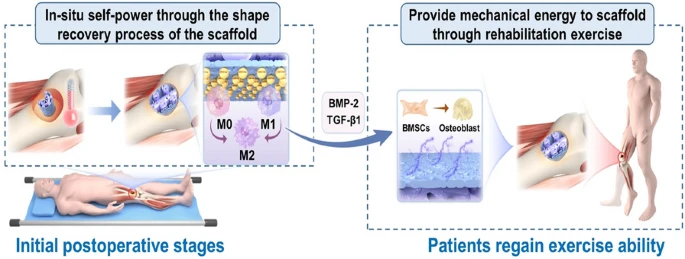
Schematic diagram of preparation and design concept of the 3D printed in-situ self-powered scaffold. A The preparation process of the 3D printed in-situ self-powered scaffold. B The mechanism of achieving in-situ self-power in vivo by integrating the shape memory process and piezoelectric effect. The scaffolds feature a customized structure capable of structural and functional transformation triggered by physiological temperature, which can be used for minimally invasive implantation. During the initial postoperative period, the scaffold can generate electrical charge through the shape memory process to modulate the immune microenvironment. As treatment progresses, continuous mechanical force stimulation can be applied to the scaffold through rehabilitation exercises when the patient regains exercise ability, enabling the scaffold to output voltage and stimulate stem cell osteogenic differentiation.
Smart 3D-printed scaffold expands with body heat and uses motion to boost bone healing.

The Bigger Picture

This isn’t just a smarter scaffold—it’s a preview of the future of personalized, self-powered healing technologies. As research progresses, the broader implications are profound:

  • Long-Term Biocompatibility: Scientists are now focused on ensuring that the scaffold remains safe and stable over time, gradually degrading without disrupting tissue or losing effectiveness. Early results show promising integration with natural bone remodeling.
  • Human Clinical Trials: The next milestone is testing this innovation in real-world medical scenarios—where it could shorten recovery, reduce the need for repeat surgeries, and improve long-term outcomes for patients with complex fractures.
  • Beyond Bones: The foundational technology—shape-memory materials plus piezoelectric fibers—can be adapted for other tissues like muscles, nerves, or even skin. That means this platform could power a new generation of smart implants across regenerative medicine.
  • Energy-Free Implants: This breakthrough points to a future where implants don’t rely on batteries or external devices at all. Instead, they’ll harvest biomechanical energy from within the body—making treatment more efficient, less invasive, and far more sustainable.

Wrap-Up / Takeaway

This isn’t just a new way to patch a bone—it’s a leap into a smarter future of medicine. The 3D-printed shape-memory piezoelectric scaffold stands out because it works with the body, not just inside it. By turning heat and movement into healing energy, it rewrites what we expect from implants: no wires, no batteries, just natural motion turned into medicine.

The research doesn’t just show it’s possible—it proves it works. And with clinical trials on the horizon, we could soon see a shift in how bone injuries are treated worldwide. It’s the start of a new era where implants are active allies in recovery.

Original Research Reference:
Li, B., Ma, Y., Fatima, K., Zhou, X., Gu, X., Chen, S., & He, C. (2025). 3D printed shape-memory piezoelectric scaffolds with in-situ self-power properties for bone defect repair. Journal of Nanobiotechnology, 23, Article 244. https://doi.org/10.1186/s12951-025-03325-x

Ready to explore more about this revolutionary technology?
Subscribe to our newsletter for the latest updates on advanced medical implants and regenerative medicine breakthroughs, or contact us today to learn how you can be part of the future of bone tissue engineering!

TAGGED:3D printed scaffoldsbone defect repairpiezoelectric materialsregenerative medicinesmart implants
Share This Article
Facebook Twitter Copy Link

Stay Up To Date!

Sign up for 3DShoes.com's mailing list where you will stay up-to-date with latest trends, drops, and more.

loader

Trending

Soft Material 3D Printing Gets Real: Inside UWyo’s RAM Lab — and What It Means for Footwear, Helmets, and Healthcare

TL;DR Quick Primer: Why “Soft” Is So Hard to Print Most printers crush hard plastics.…

August 20, 2025

Fitasy Stride vs Recovery Shoes — Which Is Better for Post-Run Recovery?

After a long run your legs want two things: cushion and relief. But which is…

January 31, 2026

MIT & Autodesk: How 3D‑Printed Concrete Is Rewriting Bridge Design — and What Footwear Makers Can Learn

MIT’s 3D-printed concrete research at Autodesk’s Boston Technology Center shows how large-scale additive design can…

November 7, 2025
PixelCrafted banner ad bold headline ‘Websites That Sell’, tagline ‘Custom WordPress builds that convert’, button ‘Get a Free Mockup’.
5.9kLike
4kFollow
3.7kPin
3.7kFollow
News

Justin Bieber x Zellerfeld Reveal the Earth Bender — A 3D-Printed, Soccer-Inspired Shoe for SKYLRK

Skylrk Earth Bender shoe. Courtesy

The Earth Bender — debuting in “Lilac” at SKYLRK’s Tokyo pop-up — marks the brand’s next step into molded, 3D-printed footwear made with Zellerfeld.

R_Shoes December 6, 2025

Your may also like!

Stride - 3D Printed Sneaker
Innovation & Trends

Fitasy Stride vs Recovery Shoes — Which Is Better for Post-Run Recovery?

R_Shoes January 31, 2026
FORMISM by SCRY
News

How Formism and Bambu Lab Are Rewriting Footwear: Inside the Persona 3D-Printable Shoe Launch

R_Shoes January 21, 2026
Syntilay Pulse Podz
Innovation & Trends

PulsePodz Review — Is Syntilay’s 3D-Printed Recovery Slide Worth $149?

R_Shoes January 19, 2026
Close-up of STARAY’s NEOHEX lattice sole technology from the CES 2026 showcase
News

STARAY CES 2026 Reception — What Attendees Said, On-Site Sales & Award Wins

R_Shoes January 14, 2026
Our website stores cookies on your computer. They allow us to remember you and help personalize your experience with our site.

Read our privacy policy for more information.

Quick Links

  • Home
  • About
  • STL Files
  • Contact
  • Shoes

Legal

  • Privacy Policy
  • Cookie Policy (EU)
  • Disclaimer
  • Terms & Conditions

Socials

Follow US
Crafted with love by PixelCrafted.Dev ❤
Manage Consent
To provide the best experiences, we use technologies like cookies to store and/or access device information. Consenting to these technologies will allow us to process data such as browsing behavior or unique IDs on this site. Not consenting or withdrawing consent, may adversely affect certain features and functions.
Functional Always active
The technical storage or access is strictly necessary for the legitimate purpose of enabling the use of a specific service explicitly requested by the subscriber or user, or for the sole purpose of carrying out the transmission of a communication over an electronic communications network.
Preferences
The technical storage or access is necessary for the legitimate purpose of storing preferences that are not requested by the subscriber or user.
Statistics
The technical storage or access that is used exclusively for statistical purposes. The technical storage or access that is used exclusively for anonymous statistical purposes. Without a subpoena, voluntary compliance on the part of your Internet Service Provider, or additional records from a third party, information stored or retrieved for this purpose alone cannot usually be used to identify you.
Marketing
The technical storage or access is required to create user profiles to send advertising, or to track the user on a website or across several websites for similar marketing purposes.
  • Manage options
  • Manage services
  • Manage {vendor_count} vendors
  • Read more about these purposes
View preferences
  • {title}
  • {title}
  • {title}
Stay Up To Date!

Sign up for 3DShoes.com's mailing list where you will stay up-to-date with latest trends, drops, and more.

loader

Zero spam, Unsubscribe at any time.
adbanner
AdBlock Detected
Our site is an advertising supported site. Please whitelist to support our site.
Okay, I'll Whitelist
Welcome Back!

Sign in to your account

Lost your password?