3D Shoes 3D Shoes
  • News
  • Innovation
  • Design
  • Companies
  • Shoes
Reading: Low-Temperature 3D-Printed Glass: MIT’s Inorganic-Composite Ink Revolution
Follow 3DShoes on LinkedIn
Font ResizerAa
3DShoes3DShoes
  • Home
  • About
  • Shoes
  • Companies
  • Innovation
  • Design
  • News
  • Guides
  • Shoes
First Pro-baseball player 3D Printed Cleats

First Pro-baseball player 3D Printed Cleats

R_Shoes R_Shoes June 26, 2024
5.9kLike
4kFollow
3.7kPin
3.7kFollow
  • 3D Printed Shoes
  • 3D Companies
  • About
  • STL Files
  • Contact
© 2026 3DShoes.com. All Rights Reserved.
News

Low-Temperature 3D-Printed Glass: MIT’s Inorganic-Composite Ink Revolution

R_Shoes
Last updated: June 23, 2025 9:10 am
By R_Shoes 7 Min Read
Share
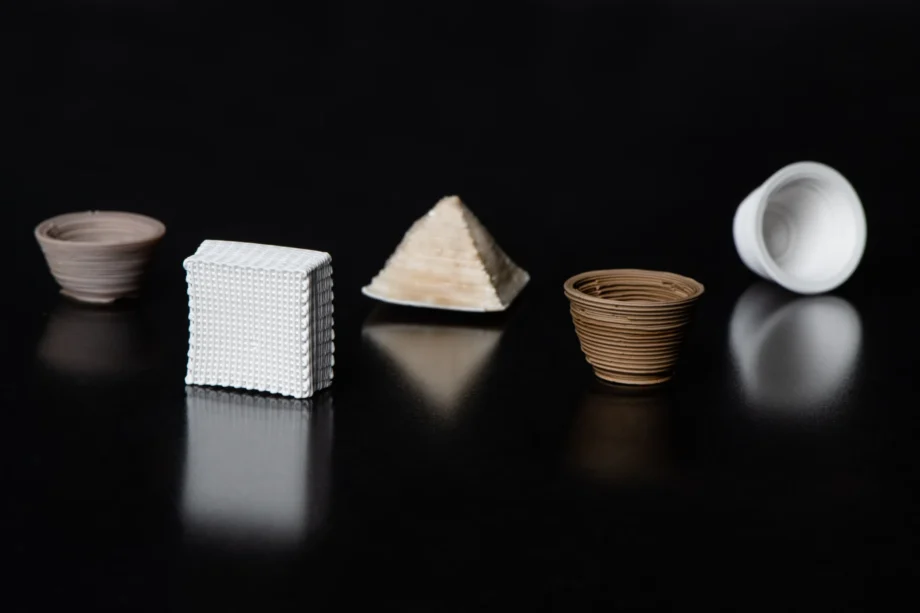
Array of low-temperature 3D-printed glass test shapes created at MIT Lincoln Laboratory
Prototype cube, pyramid, and coil printed at just 250 °C | © MIT Lincoln Laboratory / Nicole Fandel
SHARE

For centuries, shaping real glass has meant working in a furnace hot enough to soften sand—well above 1,000 °C. That energy barrier has fenced additive manufacturing (AM) out of one of the world’s most useful materials. In June 2025, researchers at MIT Lincoln Laboratory (LL) vaulted that fence: they demonstrated a direct‑ink‑writing (DIW) process that prints solid, silica‑based glass at room temperature and cures it at just 250 °C—one quarter of the heat required for ordinary glassblowing.[1]

Table of Contents
Why Glass 3D Printing Needed a BreakthroughInside the Inorganic‑Composite Glass InkStep‑by‑Step: Direct‑Ink Writing & 250 °C CureMaterial Performance: How Good Is the Glass?MIT vs. Legacy Glass AM—Quick ComparisonApplications Unlocked by Low‑Heat Printing6.1 Microfluidics & Lab‑on‑Chip6.2 Free‑Form Optics6.3 High‑Temperature Electronics6.4 Fashion & FootwearCommercialization Roadmap & Remaining HurdlesConclusion & Call‑to‑ActionReferences

This article unpacks (1) why glass AM needed a radical rethink, (2) the chemistry behind LL’s inorganic‑composite glass ink, (3) the four‑step print‑and‑cure workflow, (4) performance data, (5) a side-by-side comparison with legacy glass AM, (6) the cross‑industry applications unlocked by low‑heat printing, and (7) the commercialization path ahead.


Why Glass 3D Printing Needed a Breakthrough

  1. Extreme melt point & energy cost
    • Pure silica softens at ≈ 1,700 °C; soda‑lime at ≈ 1,400 °C. Running kilns or nozzle heaters at those temperatures devours energy and limits printer design.[2]
  2. Legacy high‑heat AM
    • G3DP (2015)—MIT’s first molten‑glass printer—extruded 1,900 °F (~1,040 °C) glass to create museum‑quality vases. Beautiful, but it required a triple‑chamber furnace and gravity‑fed flow, confining geometry and scalability.[3]
    • Nanoparticle‑resin stereolithography (Glassomer, 2018‑) mixes silica into a UV‑curable polymer, prints at ≈ 60 °C, then sinters the part at > 1,100 °C. Benefits: optical clarity; drawbacks: 10–20 % shrinkage, cracking risk, furnace bottleneck.[4]
  3. Core pain points
    • Optical cloudiness in low‑temp binder systems
    • Warping / brittleness during furnace ramp‑up or cool‑down
    • Capital cost of heat‑resistant print heads, kilns, and safety infrastructure

Timeline Snapshot 2015 → 2025
2015 G3DP ➜ 2018 Glassomer ➜ 2023 Nano‑optical resin ➜ 2025 LL composite ink (250 °C)


Inside the Inorganic‑Composite Glass Ink

ComponentFunction
Silicate solutionLiquid binder that polymerizes into a rigid network at RT
Silica nanoparticlesPrimary glass former; nanoscale size (< 100 nm) speeds packing
Dopant oxides (TiO₂, ZnO, etc.)Tailor refractive index, coloration, or conductivity
Rheology modifiersKeep viscosity in the 10²–10³ Pa·s “toothpaste” window for syringe extrusion

LL’s chemists engineered the ink so that colloidal silica disperses homogeneously. Ambient CO₂ and moisture trigger a sol‑gel polymerization that locks particles into a “green” body stiff enough to support subsequent layers.[5]

LL Key Feature: “Composite glass parts show < 2 % linear shrinkage after oil cure—an order of magnitude lower than polymer‑burnout systems.”[1]

Because every ingredient is inorganic, no carbon skeleton remains to burn out; that’s how LL sidesteps the 1,100 °C sinter of Glassomer.


Step‑by‑Step: Direct‑Ink Writing & 250 °C Cure

  1. Room‑temperature printing – A gantry or delta head lays continuous filaments (~100 µm tip) on a standard build plate; no heaters or inert chambers required.[2]
  2. In‑situ polymerization – Printed beads cross‑link into a silica network within minutes, producing a freestanding “green” object.
  3. Mineral‑oil cure – The part is submerged at ≈ 250 °C for ~2 hours. Oil prevents oxidation and provides uniform heat, densifying the matrix without reaching silica’s glass‑transition temperature.[1]
  4. Solvent rinse – A quick wash in isopropanol removes surface oil, leaving a fully inorganic glass ready for use.[6]
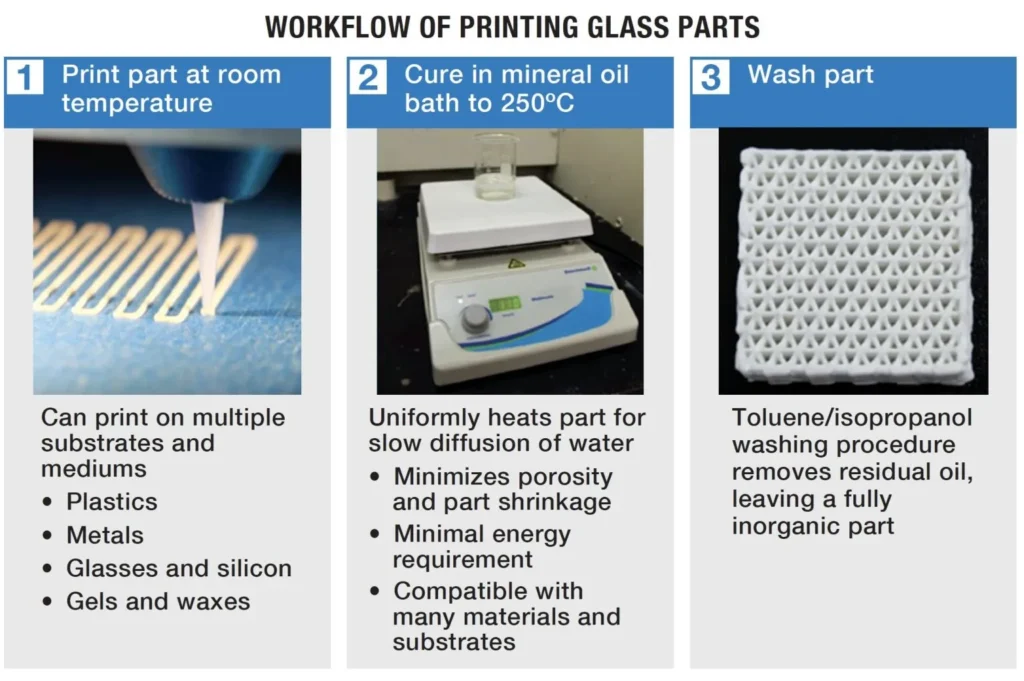
Infographic showing the four-step low-temperature glass-printing workflow
Four-step workflow: print → oil cure 250 °C → wash → finished glass | Courtesy of VoxelMatters, adapted from MIT LL data

Material Performance: How Good Is the Glass?

PropertyLow‑Temp CompositeSoda‑Lime Glass
Feature resolution< 100 µm channels[7]n/a (cast)
Linear shrinkage< 2 %[1]n/a
Young’s modulus~55 GPa (prelim)70 GPa
Thermal stabilitySurvives > 400 °C bake without cracking[7]Melts at ~600 °C
Optical clarityTranslucent (hazy)—R&D ongoing[8]Transparent
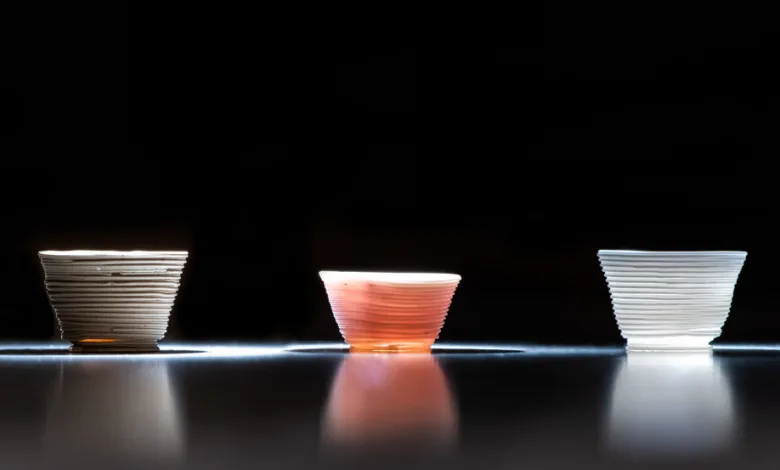
Low-temperature 3D-printed glass bowl with concentric filament layers
Complex bowl geometry produced with the new composite-ink method | © MIT Lincoln Laboratory

LL parts handle thermal cycling to 400 °C and show high chemical resistance, ideal for acid‑handling microfluidic chips.[7] The main gap is haze; research targets nanopore removal and low‑vacuum fire‑polishing.[8]


MIT vs. Legacy Glass AM—Quick Comparison

MetricMIT Low‑Temp (2025)G3DP Molten (2015)Glassomer SLA (2018)
Print tempRT → 250 °C~1,040 °C~60 °C
Post‑process250 °C oil cureNone (cool)1,100 °C sinter
Shrinkage< 2 %< 1 %10–20 %
Equipment cost<$50 k syringe printerCustom kiln‑printerUV laser + furnace
Optical qualityHazy‑transparentClearClear

Sources: LL technical brief; Tom’s Hardware (18 Jun 2025); Glassomer whitepaper.[1][3][4]


Applications Unlocked by Low‑Heat Printing

6.1 Microfluidics & Lab‑on‑Chip

  • Print chemically inert channels down to 150 µm—no wafer bonding. TAM: $1.4 B by 2030 (diagnostics).⁹

6.2 Free‑Form Optics

  • DIW enables gradient‑index lenses and internal waveguides impossible with molds.

6.3 High‑Temperature Electronics

  • Glass encapsulation printed over SiC/GaN power devices for heat spreading; survives reflow.

6.4 Fashion & Footwear

  • Transparent lattice heels, jewel‑like uppers, back‑lit glass windows in sneakers. Weight trade‑offs mitigated via hybrid composites. Recyclability adds sustainability appeal.
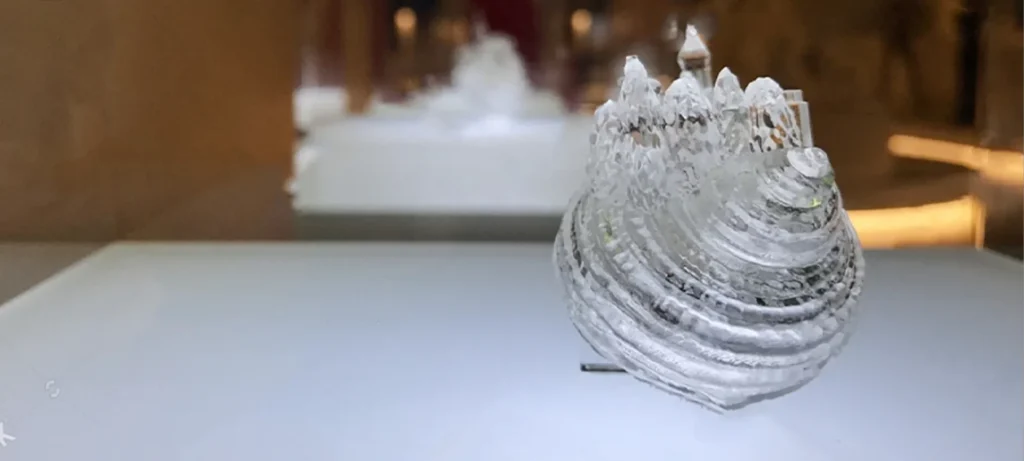
Transparent 3D-printed glass sculpture from an earlier high-heat process
Legacy high-heat print shows the clarity target researchers aim to reach | Image via Pick3DPrinter / MIT Media Lab (fair-use editorial)

Cross‑Industry Growth 2026–2031
Optics: 28 % CAGR
Bio‑microfluidics: 24 % CAGR
Wearable design: emerging high‑margin niche
(Data: VoxelMatters + SmarTech AM)[7]


Commercialization Roadmap & Remaining Hurdles

  1. Transparency optimization – Aim for < 1 % haze via vacuum anneal or solvent exchange.
  2. Desktop printer kits – Integrate heated‑oil cure; sub‑$10 k target by 2027.
  3. Standards – Draft ASTM “Composite Glass Ink” spec & ISO mechanical tests.
  4. IP & funding – LL filed U.S. patents (17/908,xxx series); 10+ startups launched post‑announcement (e.g., ClearInk AM, OptiGlass 3D).

Market analysts forecast ~18 % CAGR for glass AM 2025‑2030, outpacing polymer AM.[8]


Conclusion & Call‑to‑Action

MIT LL’s 250 °C composite‑ink process demolishes the notion that glass AM must live inside a furnace. By slashing energy use and expanding design freedom, it invites innovators—from lab‑chip engineers to couture designers—to rethink what they can do with real glass.

Ready to explore further?

  • Subscribe to our newsletter for monthly teardown videos of emerging AM materials.
  • Share this article with a colleague in optics, biotech, or design—the next killer application might start with your forward.

The kiln door is open; walk through it at room temperature.


References

[1] MIT Lincoln Laboratory PDF — Low‑Temperature Additive Manufacturing of Glass.
[2] MIT LL news release (June 2025).
[3] Tom’s Hardware coverage (18 Jun 2025).
[4] Glassomer whitepaper (2018).
[5] LL Composite‑Ink Rheology Study (2025).
[6] 3DPrinting.com feature (June 2025).
[7] VoxelMatters analysis (June 2025).
[8] SmarTech AM Market Report (Q1 2025).
[9] Global Microfluidics Market Outlook (2024‑2030).
TAGGED:direct ink writingglass additive manufacturinginorganic composite glass inklow-temperature 3D-printed glassmicrofluidic glass printing
Share This Article
Facebook Twitter Pinterest Whatsapp Whatsapp LinkedIn Reddit Telegram Email Copy Link Print

Launching something like this?

If you're working on a product, platform, or business, I design fast, SEO-structured WordPress websites built for real results..

Start Your Project
100+ websites built • 15+ years experience

Stay Up To Date!

Sign up for 3DShoes.com's mailing list where you will stay up-to-date with latest trends, drops, and more.

loader

Website Help

Need a website for your project?

I build clean, fast, SEO-structured WordPress websites for real business results.

Start Your Project
100+ websites built • 15+ years experience

Trending

Top 10 best 3D-printed shoes of 2025 featuring futuristic lattice-sole sneakers for performance and lifestyle wear
Top 10 Best 3D-Printed Shoes of 2025 — Performance, Fashion & Value
December 27, 2025
Syntilay Pulse Podz
PulsePodz Review — Is Syntilay’s 3D-Printed Recovery Slide Worth $149?
January 19, 2026
A close-up of a modern 3D printer creating a small figurine, representing digital manufacturing and copyright issues.
3D Printing and Copyright: When Does Making a Replica Become a Crime?
November 9, 2025
Skylrk Earth Bender shoe. Courtesy
Justin Bieber x Zellerfeld Reveal the Earth Bender — A 3D-Printed, Soccer-Inspired Shoe for SKYLRK
December 6, 2025

3D Printed Shoes →

3D Printing Companies →

Topics

  • Innovation
  • Design
  • News
  • Guides
  • Products
Follow 3DShoes on LinkedIn

Affiliate links on 3DShoes may earn us a commission. Learn more.

News

How Formism and Bambu Lab Are Rewriting Footwear: Inside the Persona 3D-Printable Shoe Launch

FORMISM by SCRY

Introduction — downloadable shoes, at last A small but significant shift in how we obtain footwear has moved from concept to market. FORMISM — a digital production studio created by…

January 21, 2026 News

Your may also like!

adidas Project RAP football boot concept performance testing
Innovation & Trends

Inside adidas’ 3D-Printed Football Boot: What We Know (and What’s Missing)

R_Shoes April 10, 2026
Innovation & Trends

Best 3D Printing Service in 2026

R_Shoes April 10, 2026
Nike Air Works
News

Inside Nike Air Works: The 3D-Printed Air Max Program Explained

R_Shoes April 10, 2026
adidas Project R.A.P 3D-printed performance footwear concept
News

What Is adidas Project R.A.P? The Future of 3D-Printed Performance Footwear Explained

R_Shoes March 25, 2026

NEWSLETTER

Stay Updated on 3D Footwear Innovation

Get the latest insights, breakthroughs, and industry updates delivered to your inbox.

loader

No spam. Just relevant industry updates.

3D Shoes

3DShoes tracks the evolution of 3D-printed footwear—covering design, technology, and manufacturing to help make sense of where the industry is heading.

Quick Links

  • 3D Printed Shoes
  • 3D Companies
  • About
  • STL Files
  • Contact

Legal

  • Privacy Policy
  • Cookie Policy (EU)
  • Disclaimer
  • Terms & Conditions

Socials

Our website stores cookies on your computer. They allow us to remember you and help personalize your experience with our site. Read our privacy policy for more information.

© 2026 3DShoes – All Rights Reserved. Hosted & Developed by PixelCrafted.Dev.

Manage Consent
To provide the best experiences, we use technologies like cookies to store and/or access device information. Consenting to these technologies will allow us to process data such as browsing behavior or unique IDs on this site. Not consenting or withdrawing consent, may adversely affect certain features and functions.
Functional Always active
The technical storage or access is strictly necessary for the legitimate purpose of enabling the use of a specific service explicitly requested by the subscriber or user, or for the sole purpose of carrying out the transmission of a communication over an electronic communications network.
Preferences
The technical storage or access is necessary for the legitimate purpose of storing preferences that are not requested by the subscriber or user.
Statistics
The technical storage or access that is used exclusively for statistical purposes. The technical storage or access that is used exclusively for anonymous statistical purposes. Without a subpoena, voluntary compliance on the part of your Internet Service Provider, or additional records from a third party, information stored or retrieved for this purpose alone cannot usually be used to identify you.
Marketing
The technical storage or access is required to create user profiles to send advertising, or to track the user on a website or across several websites for similar marketing purposes.
  • Manage options
  • Manage services
  • Manage {vendor_count} vendors
  • Read more about these purposes
View preferences
  • {title}
  • {title}
  • {title}
Stay Up To Date!

Sign up for 3DShoes.com's mailing list where you will stay up-to-date with latest trends, drops, and more.

loader

Zero spam, Unsubscribe at any time.
adbanner
AdBlock Detected
Our site is an advertising supported site. Please whitelist to support our site.
Okay, I'll Whitelist
Welcome Back!

Sign in to your account

Lost your password?