


Introduction
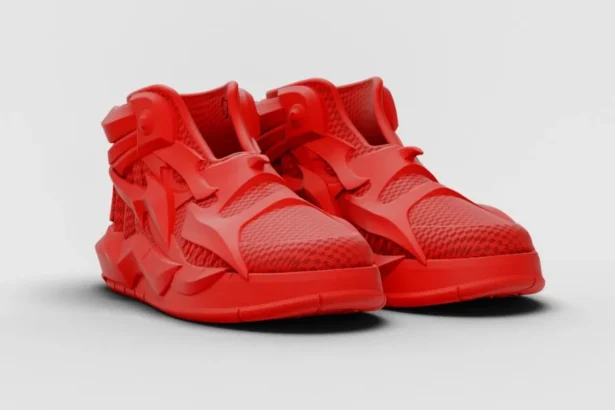
Imagine a production floor where an entire shoe — upper and sole — is printed as a single recyclable object in under an hour, where failed parts and trimmings are fed directly back into the production line, and where design changes ship the same week instead of after months of tooling. That’s the promise behind ARKKY’s next-generation plant. This article walks a factory-style tour of a modern 3D printed shoes factory, explaining the hardware (TAPS printers), the proprietary AI-HALS light-curing process, the mono-material strategy and closed-loop resin recycling, the quality controls that protect product integrity, and the business and environmental tradeoffs of scaling additive manufacturing for footwear.
Throughout, claims that come from the manufacturer are marked as brand-reported. Where data is missing — for example, energy per pair or the number of safe reprocessing cycles for resin — we flag those gaps and recommend verification steps for rigorous reporting.
Factory layout: designed for flow, not tooling
A 3D printed shoes factory moves the value-creation point from steel tooling to digital printers. Instead of dedicated injection molds and assembly lines, ARKKY organizes its floor around modular printing cells, post-processing lanes, and a tightly integrated recycling loop.
Key zones:
- Resin intake & storage: segregated tanks for virgin and reprocessed photopolymer, batch-tracked and temperature-controlled.
- Printing cells (TAPS arrays): modular rows of TAPS printers with quick-change build plates to minimize downtime.
- Post-processing: automated wash stations (if needed), conveyorized UV ovens for post-cure, and trimming stations.
- QC & packing: vision inspection, mechanical spot testing, and final human checks before boxing.
- Recycling station: grinding, filtering, and reconditioning equipment that turns cured scrap back into feedstock.
Why a cell-based layout? Cells isolate failures, enable robotic handling (AGVs, cobots), and let teams scale by adding printer clusters rather than whole new lines. ARKKY reports that each HALS/TAPS device can produce hundreds of shoes per day under ideal conditions — a claim that depends on build volume, cycle times, and uptime, and should be verified with utilization logs when possible.

The machines and the magic: TAPS printers + AI-HALS
At the heart of ARKKY’s throughput claim is a two-part system: TAPS printers (hardware optimized for footwear) and an AI-driven Hindered Asynchronous Light Synthesis (AI-HALS) curing process.
How AI-HALS differs from traditional resin printing
Conventional vat photopolymerization (DLP/SLA) builds parts layer-by-layer and often uses mechanical peeling between layers. AI-HALS changes that by:
- Dampening the photoreaction with inhibitors so the resin does not instantly solidify when exposed to light.
- Creating a narrow reaction zone where synchronized high-speed light arrays and precise platform movement form a continuously cured volume.
- Using AI control to modulate light intensity, timing, and patterning in real time for geometric fidelity and speed.
This continuous-curing approach reduces peel-stress failures and enables much larger, faster builds — crucial when printing full shoes as a single job.
Practical outcomes on the floor
- Cycle time reduction: ARKKY reports per-shoe prints in the 20–60 minute range versus many hours for traditional systems. The company cites a 20–100× throughput multiplier as an idealized comparison point.
- Large build area capability: whole-shoe jobs (upper + sole) are feasible, enabling monolithic prints without glues or assembly.
- Software integration: an MES schedules jobs, tracks resin lot IDs, and captures process telemetry; AI models tune cure profiles to material batches.
Caveats: faster curing concentrates energy draw into short bursts. Energy per pair matters for lifecycle emissions; ask for kWh/pair to assess environmental tradeoffs.
Materials strategy: mono-materials and closed-loop recycling
ARKKY’s sustainability story centers on a mono-material approach: the entire shoe is printed from a single photopolymer resin — a TPU-like bio-blend that the company reports contains ~53% biological content.
Why mono-materials matter
Multi-material shoes (foam midsoles + rubber outsoles + textiles + adhesives) are notoriously hard to recycle. A single-material shoe can be ground and reprocessed mechanically, enabling a circular loop rather than downcycling or landfill disposal.
The recycling loop, step-by-step
- Collection: production scraps, rejected prints, and customer returns are kept in a closed stream.
- Comminution: cured parts are ground into granulate or powder.
- Reconditioning: ground material is filtered and blended with virgin resin as needed; viscosity and photochemical properties are restored.
- Validation: batches are tested for modulus, elongation, and fatigue before reintroduction to production.
Important verification points: “53% bio-based” can mean different things (mass %, carbon %, or specific bio-derived monomers). Also, repeated mechanical reprocessing typically degrades polymer chain length; ask for ARKKY’s data on mechanical properties after multiple reprocessing cycles to know how many times material can be reused.

Post-processing and quality control: automated + human oversight
Printing eliminates many assembly steps but not quality control. ARKKY’s workflow combines automated inspection with selective human checks.
Typical QC measures:
- Vision inspection: camera systems check geometry, surface defects, and obvious porosity.
- Mechanical spot tests: compression, rebound, and abrasion jigs validate midsole behavior.
- Batch grading: prints are sorted into A/B/C bins; A ships, B may be reworked, and C is recycled.
- Traceability: barcode or RFID tagging of build plates and lot IDs for recalls and warranty claims.
Requestable data: pass/fail thresholds (dimensional tolerance, compression set, rebound %) and examples of rejected-part rates — these numbers determine real yield and the amount of material returning to the recycling loop.
Throughput, costs, and the economics of scale
Additive manufacturing shifts cost structure from tooling cost to machine and material cost. Key variables determine whether a 3D printed shoes factory is financially competitive:
- Printer utilization: actual uptime and build stacking determine pairs/day per machine. Manufacturer throughput claims should be backed by utilization logs.
- Resin cost & yield: price per kilogram and grams-per-pair determine material cost; reprocessed feedstock reduces OPEX.
- Energy consumption: high-power LEDs and ovens affect both cost and carbon footprint.
- Labor & automation: automation reduces direct labor but requires investment in robotics and MES integration.
Benefits versus injection molding:
- No tooling lead time — rapid design iteration and on-demand inventory.
- Lower MOQ risk for drops and limited runs.
- Potential for personalization without expensive tooling variants.
Tradeoffs:
- Higher per-unit material cost at high volume if resin remains pricier than commodity EVA.
- Energy and machine CAPEX can be significant; include energy per pair and machine amortization in any cost model.
Environmental reality check: interpreting “zero waste”
“Zero waste” is a powerful claim but requires nuance. In practice, a credible zero-waste factory demonstrates:
- High percentage of production material recovered and reintroduced into feedstock.
- A functioning take-back program that captures meaningful post-consumer return rates.
- Evidence that reprocessed material retains performance across multiple cycles.
- Low net landfill/incineration rates for product lifecycle.
Potential offsets to consider: the energy intensity of rapid, high-power curing; emissions from resin production; and the logistics footprint of collecting and transporting returns.
A full cradle-to-grave LCA is the standard way to compare a mono-material 3D-printed shoe to a conventional multi-material sneaker. If ARKKY can provide kWh/pair and a third-party LCA, that would substantiate the environmental claims.
Conclusion: potential and proof points
ARKKY’s smart factory model shows how additive manufacturing can be engineered for both speed and circularity: AI-HALS and TAPS printers enable high-throughput monolithic shoes, while a closed-loop resin strategy reduces production scrap and simplifies end-of-life processing. That combination positions 3D printing as a viable path toward lower-waste footwear production — provided key metrics are disclosed and verified.
For editors and readers seeking a definitive verdict, ask for the following data: measured uptime and printer utilization, energy per pair (kWh), percentages of material recovered and reused, and mechanical performance after repeated reprocessing cycles. With those figures in hand, the promise of a near-zero-waste 3D printed shoes factory becomes measurable and comparable to conventional manufacturing.
Sources & further reading
- VoxelMatters — “ARKKY’s next-gen 3D printed shoes blend design, innovation, and sustainability” — Industry coverage and summary of ARKKY’s claims and product direction.
https://www.voxelmatters.com/arkkys-next-gen-3d-printed-shoes-blend-design-innovation-and-sustainability/ . - ARKKY — Official tech overview (Explore tech) — ARKKY’s description of AI-HALS, TAPS printers, materials, and their sustainability claims.
https://arkky.com/pages/explore-tech. - ARKKY — Tech announcement / blog: “Tech Upgrade: ARKKY Launches a New Generation of 3D Printed Footwear” — company blog post explaining HALS, bio-blend resin, and product lines. Useful for product names, retail prices, and R&D quotes.
https://arkky.com/blogs/news/tech-upgrade-arkky-launches-a-new-generation-of-3d-printed-footwear. - ARKKY — AI-HALS announcement (speed claims) — ARKKY blog post that summarizes the 20–100× throughput claim and HALS mechanics.
https://arkky.com/blogs/news/arkky-ai-hals-technology-boosts-3d-printed-shoes-speed-by-20-100x. - ScienceDirect — “Cost-effective recycled resin for digital light processing 3D printing” (Journal of Cleaner Production) — peer-reviewed research demonstrating practical closed-loop/ mechanical recycling of photocured resins.
https://www.sciencedirect.com/science/article/abs/pii/S0959652623001713. - Nature — “A renewably sourced, circular photopolymer resin for additive manufacturing” (Nature) — high-level research on circular photopolymer resins and closed-loop chemical recycling strategies.
https://www.nature.com/articles/s41586-024-07399-9. - ACS Applied Materials & Interfaces — “Biobased Photopolymer Resin for 3D Printing Containing Dynamic Imine Bonds for Fast Reprocessability” — technical paper showing bio-based photopolymer formulations designed for mechanical reprocessing.
https://pubs.acs.org/doi/10.1021/acsami.3c01669. - Wired — Carbon3D / CLIP background: “Carbon3D printer is super speedy thanks to light and oxygen” — historical context on continuous photopolymerization approaches (CLIP) that are conceptually related to HALS-style continuous curing. Helpful for a “how this compares” section.
https://www.wired.com/story/carbon3d-ted. - Wired — Adidas Futurecraft.Loop coverage — case study of a mono-material, fully recyclable commercial shoe.
https://www.wired.com/story/adidas-futurecraft-loop-running-shoe-recycle. - 3DPrinting.com — “Researchers develop bio-based resins for recyclable 3D printing” — accessible coverage of university research on recyclable, bio-based resins that supports material-innovation claims.
https://3dprinting.com/news/researchers-develop-bio-based-resins-for-recyclable-3d-printing/. - Frontiers — Research on individualized 3D-printed footwear and foot biomechanics — useful when referencing biomechanical personalization and comfort claims.
https://www.frontiersin.org/articles/10.3389/fevo.2023.1270253/full.