Introduction — downloadable shoes, at last
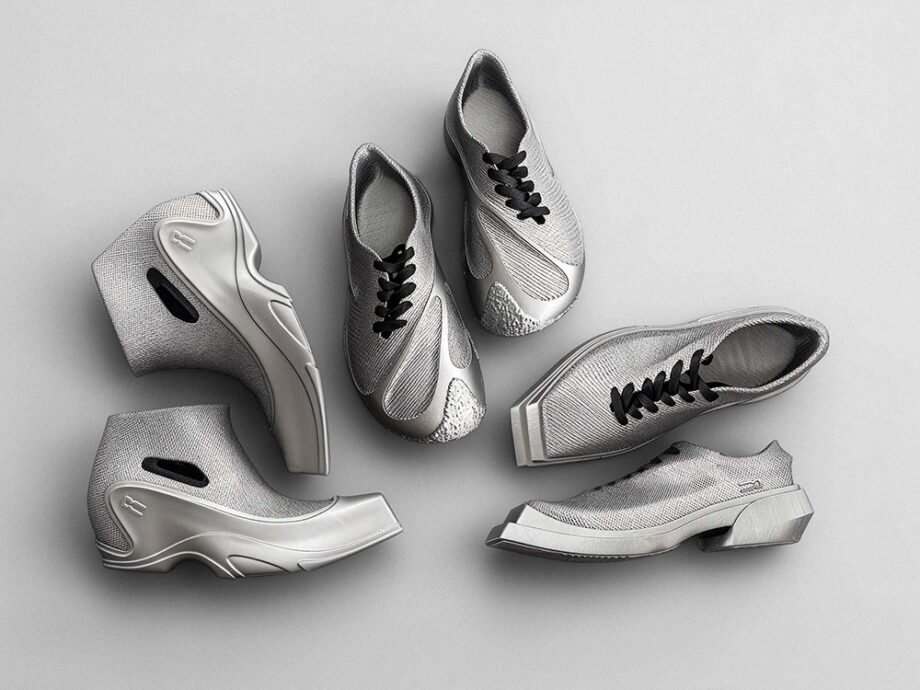
A small but significant shift in how we obtain footwear has moved from concept to market. FORMISM — a digital production studio created by SCRY — released the Persona collection on MakerWorld, Bambu Lab’s curated marketplace for 3D models and crowdfunding. Instead of shipping finished pairs from centralized factories, Formism sells finished design files that users can download, customize and print at home or opt into a fulfilment tier where Bambu Lab prints a physical pair for them. Early traction has been strong, suggesting real appetite for downloadable, maker-driven fashion.
This piece explains what Formism is, why the collaboration with Bambu Lab matters, what’s included in the Persona launch (models, pricing and fulfilment tiers), the technical and economic tradeoffs of printing footwear at home, and what designers and retailers should watch next.
What is Formism?
Formism is presented as a “digital production asset” studio operating under SCRY, focused on footwear and lifestyle products developed specifically for desktop FDM 3D printing. Rather than treating the physical shoe as the primary SKU, Formism treats the downloadable, production‑ready model as the product: design files, print profiles, material guidance and documentation are the deliverable.
The Persona release (Persona Heel, Persona Unisex, Persona Sneaker) is Formism’s most publicized asset package to date. The strategic implication is clear: value shifts from inventory and logistics to IP, documentation and the user experience of printing and finishing the product.
Why the Bambu Lab MakerWorld launch matters
MakerWorld bundles three functions that designers need to scale downloadable products: file hosting and distribution, community engagement, and optional fulfilment pathways. For Formism, launching on MakerWorld provides immediate access to an audience of makers and direct integration with the company that manufactures the desktop printers expected to run the files reliably.
For Bambu Lab, MakerWorld is maturing from a hobbyist model repository into a marketplace and light fulfilment ecosystem. That evolution converts printer sales into recurring digital revenue opportunities and positions desktop machines as nodes in a new manufacturing and distribution system.
What’s in the Persona collection: models, packages and pricing
Models included
- Persona Heel Shoes — elevated styling, statement silhouette.
- Persona Unisex Shoes — neutral silhouette for broad wearability.
- Persona Sneaker — sportier model for daily use.
Pricing & packages
- Individual digital model: USD 49 each.
- Complete Package: all three digital models for USD 119.
- ACE Package: full digital package + option to receive a physical printed pair produced by Bambu Lab; priced at USD 459.
- Commercial license: available separately for designers who intend to use the files commercially (terms vary).
Crowdfunding traction
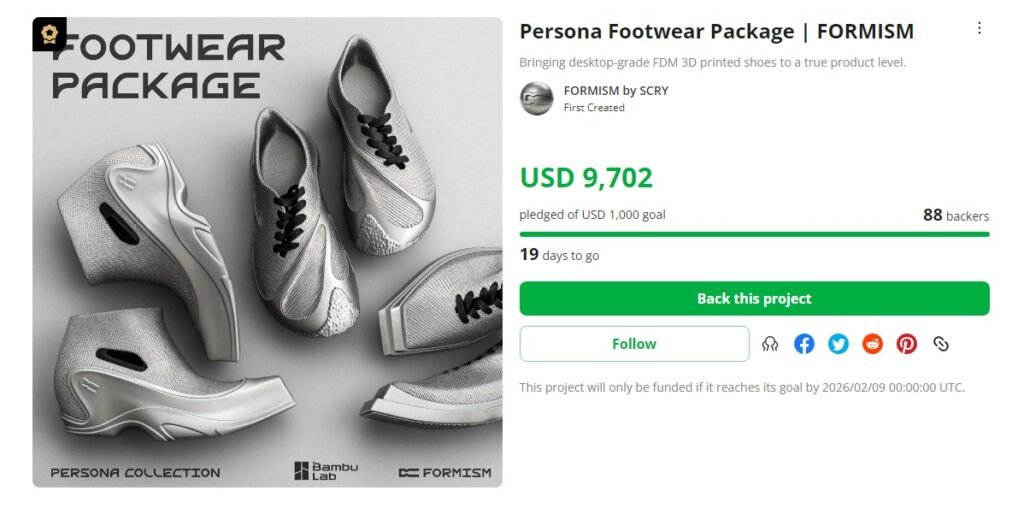
- Campaign goal: USD 1,000. Early pledges exceeded that goal many times over, signaling strong community interest and early validation for downloadable footwear assets.
Technical primer: what you need to print Formism Persona shoes at home
Printing wearable shoes on a desktop FDM machine requires attention to hardware, materials, slicing strategy and finishing.
Hardware
- Primary recommendation: Bambu Lab desktop printers (endorsed on MakerWorld and by campaign materials) — alternative high-end FDM machines with stable direct-drive extruders can work but require tuning.
Materials & multi-material strategies
- TPU is the primary material for flexible regions. Durometer selection (e.g., 85A, 90A) affects comfort and durability.
- Foam TPU (or other foaming flexible filaments) is referenced by the project roadmap as a future or companion material for better cushioning.
- Rigid or semi-rigid inserts may be printed in PLA/PC/rigid TPU depending on design.
Print settings
- Layer height: 0.12–0.20 mm balance between surface finish and print time.
- Infill: variable across regions — denser for structural zones, lattice or flexible infill for midsoles.
- Supports: consider soluble supports for complex geometries; plan for post‑support finishing.
- Post-processing: sanding, heat treatment and bonding of multi-part assemblies improve comfort and seam integrity.
Sizing workflow
- Print lightweight test pieces (toe box + heel) to verify fit before committing to a full, time‑intensive pair. Use foot measurements or scans to choose the base scale.
Economics & accessibility: cost components and who benefits
Cost components
- Digital model price: $49 per model (bundle discounts available).
- Filament: depends on weight and material; flexible filaments typically cost more per kg than PLA—per-pair filament cost can vary widely (e.g., estimated USD 5–30+ depending on print strategy).
- Printer amortization: divide purchase price over expected number of prints — higher-volume makers reduce per-pair capital cost.
- Electricity & finishing supplies: incremental but relevant for total cost.
- Fulfilment (ACE): higher price point that covers platform-managed printing and QC for buyers who don’t print themselves.
Accessibility tradeoffs
- Makers with a compatible printer enjoy low marginal costs (time and material). Non-makers can buy ACE fulfilment to avoid the skills barrier.
Design and productization challenges
Key challenges
- Durability & wear: FDM-printed components face abrasion and flex fatigue; soles are a particular concern.
- Multi-material assembly: integrating rigid and soft regions demands careful slicing or multi-extruder setups.
- Testing & compliance: consumer footwear typically follows safety and performance protocols—desktop-printed goods lack standardized testing unless produced through verified fulfilment.
- IP & licensing: digital distribution simplifies piracy; licensing clarity and enforcement are necessary for commercial scaling.
Mitigations
- Offer certified fulfilment tiers (platform-printed pairs).
- Release comprehensive print profiles and stress-test results.
- Use clear, tiered licensing (personal vs commercial).
Cultural & industry implications
Formism’s approach intersects with several macro trends:
- Democratization of manufacturing: downloadable blueprints shift power from centralized factories to designers and local makers.
- Community-driven product validation: crowdfunding and maker feedback accelerate iteration cycles and de-risk designs.
- Retail fragmentation: localized print-for-you services and microfactories may replace some inventory models.
- Marketing through making: tutorials, wear tests and user galleries become primary discovery channels.
For established brands, downloadable assets are both a potential threat (to inventory models) and an opportunity (for direct digital engagement, limited runs and co-creation).
How designers and makers can participate
Practical steps
- Design for FDM realities (overhangs, joint tolerances, assembly).
- Publish robust documentation: print profiles, recommended durometers, finishing steps and fit templates.
- Select licensing strategy (personal vs commercial).
- Use MakerWorld crowdfunding to validate demand and offer fulfilment tiers for non‑printers.
- Engage the community with galleries, wear tests and iterative updates.
Formism’s launch demonstrates this playbook in practice: clear files + documentation + fulfilment options create low-friction paths for both makers and non-makers.
Quick FAQ
Q1: Are Formism Persona shoes truly wearable for everyday use?
A: They are designed for wearable use, but long-term durability depends on material choice, print settings and wearer usage. High-wear tests are advisable before heavy use.
Q2: Do I need a Bambu Lab printer to print Persona files?
A: No — Persona files target robust desktop FDM printers and Bambu Lab is the recommended platform, but other printers that can handle flexible filaments and stable extrusion may be compatible (results vary).
Q3: What materials are recommended?
A: Flexible TPU for the upper and midsole regions; foam TPU is mentioned as a future/companion material for cushioning. Rigid inserts may use PLA or stiff TPU.
Q4: Can I sell physical shoes I print from Formism files?
A: Only if you obtain the appropriate commercial license from the designer. MakerWorld provides commercial license options — read the terms carefully.
Q5: How much does it cost to print a pair at home?
A: Total cost varies widely; expect $5–30+ in filament per pair plus marginal electricity and finishing costs (not counting printer amortization). The ACE fulfilment tier offers a no-print option at a higher price.
Q6: Where can I get verified print profiles and support?
A: MakerWorld model pages, Bambu Lab forum and the campaign’s documentation are primary sources for verified profiles and community-shared settings.
What to watch next
- More high-profile MakerWorld launches and higher pledge totals across multiple projects.
- Material availability: broader retail availability of foam TPU and multi-durometer filaments designed for wearables.
- Retail or brand experiments: established footwear brands releasing downloadable assets or partnering with local print-for-you services.
- Standards: emergence of testing/certification pathways for printed wearable goods.
Sources
- MakerWorld — Persona Footwear Package (campaign & rewards, live metrics): https://makerworld.com/en/crowdfunding/160-persona-footwear-package-formism
- MakerWorld — Persona model & downloads: https://makerworld.com/en/models/2158585-formism-persona-package-unisex-shoes
- VoxelMatters coverage — “Formism debuts on MakerWorld…” (Jan 20, 2026): https://www.voxelmatters.com/formism-debuts-on-makerworld-with-futuristic-shoes-created-in-collaboration-with-bambu-lab/
- Fabbaloo — analysis & context on Bambu Lab and printable footwear (Jan 2, 2026): https://www.fabbaloo.com/news/bambu-lab-signals-new-product-path-as-3d-printable-footwear-enters-crowdfunding
- Prismedia / industry writeup (Jan 7, 2026): https://www.prismedia.ai/news/formism-launches-multi-material-3d-printable-shoes-with-crowdfunding-on-makerworld
- All3DP — coverage and community notes (Jan 2026 roundup): https://all3dp.com/6/more-designer-footwear-coming-to-makerworld/
- Bambu Lab forum announcement (Dec 29, 2025): https://forum.bambulab.com/t/new-3d-printable-footwear-series-is-now-live-bambu-lab-x-formism-by-scry/220230
- Bambu Lab social (X/Twitter / Instagram) — campaign posts and material announcements (public posts from BambulabGlobal): https://x.com/BambulabGlobal and related IG posts
- MakerWorld Crowdfunding feature documentation (platform details): https://makerworld.com/tr/community/tag?name=Crowdfunding+Feature