As readers of 3dshoes.com, you care about how additive manufacturing reshapes design, materials, and production—whether it’s a performance midsole or a full-size bridge. At Autodesk’s Technology Center in Boston, MIT researchers are using large‑format 3D‑printed concrete to prototype hybrid bridge components that save material and rethink structural form. While the scale is very different from a shoe studio, the lessons—topology optimization, material tuning, rapid iteration, and software‑to‑fabrication workflows—map directly back to footwear innovation.
What is 3D‑printed concrete (and why you should care)
Large‑format 3D‑printed concrete is an extrusion‑based process where a gantry or robotic arm deposits cementitious material layer by layer from a digital model—no wooden formwork required. For footwear creators, that’s the same principle you see in midsole printing or lattice midsoles: print only where you need material, and tune geometry to function.
Why it matters to footwear people:
- It crystallizes a key additive advantage: geometry over bulk—use shape to get performance, not just more material.
- Process issues like rheology (how a material flows), layer bonding, and curing have direct analogs in polymer and elastomer printing.
- The Autodesk + MIT work is a real‑world reminder that software (design, simulation) + hardware (printer, material) is the combo that powers true innovation.
Infrastructure lessons that translate to design & production
MIT’s experiments emphasize three things that matter in our industry too: material efficiency, rapid prototyping, and hybrid assemblies. Research suggests topology-optimized concrete forms can cut material use significantly—figures often cited are in the realm of tens of percent depending on the part. In footwear, that’s the equivalent of shaving weight and carbon from a midsole by using lattice geometries and graded densities.
Modular printed elements—Autodesk’s “Lego‑like” blocks—mirror how brands are moving toward swappable, repairable parts for shoes. Imagine midsoles or outsoles designed as modular printed inserts for easier recycling or reparability.
Inside the lab: MIT + Autodesk, and the parallels to a shoe R&D studio
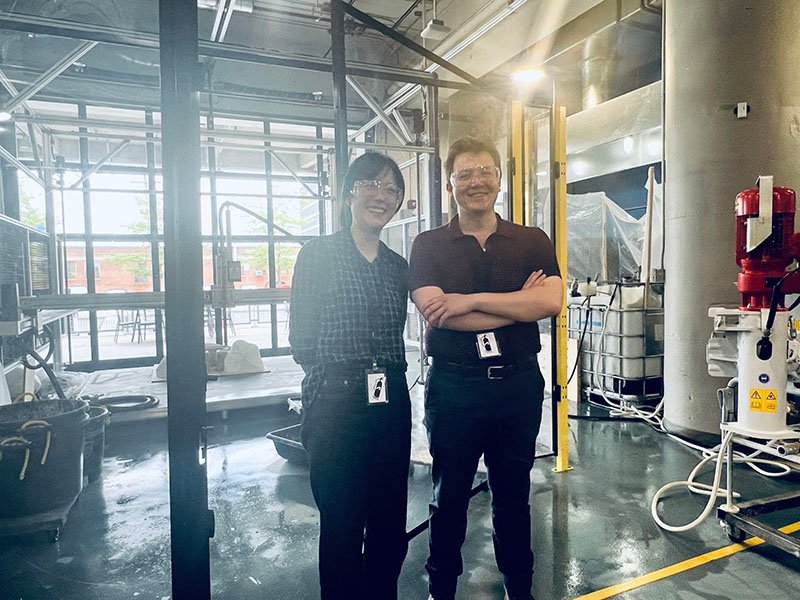
Autodesk’s Additive Studio hosts gantry printers and robotic systems where MIT prints full‑size bridge ribs and hybrid concrete‑steel parts. The workflow looks familiar to anyone who’s run a shoe prototype cycle:
- Design & simulation (Fusion, topology optimization)
- Toolpath generation and CAM (translate to machine movement)
- Material tuning and test prints (dial in flow, cure, and adhesion)
- Post‑processing and assembly (add reinforcement; final finishing)
Replace ‘concrete’ with ‘TPU, TPU‑blends, or liquid silicone’ and you’ve described a typical advanced midsole workflow. The big takeaway: investing in the software‑to‑fabrication bridge pays off fast.
How the tech actually works — printers, material tuning, and software
At scale, gantry printers deposit successive beads of a cementitious mix. The trick is rheology control—making the mix pumpable but stiff enough to hold shape immediately. In footwear, printers and processes handle similar trade‑offs with polymer melts and pastes (think TPU viscosity, curing windows, and interlayer adhesion).
Autodesk’s stack couples BIM/CAD with CAM and simulation tools to optimize geometry. In footwear terms, this is the mix of lattice design tools, finite element analysis (FEA), and slicer/CAM settings that allow you to convert a comfort map into a print-ready lattice midsole.
For reinforcement, MIT explores inserting steel channels after printing—analogy: co‑printing or embedding fibers, textiles, or inserts in a midsole for targeted stiffness.
Design strategies that cross industries: form-finding and topology optimization
Hajin Kim‑Tackowiak’s line—“The most aesthetically beautiful structures are the ones directly informed by physics”—is a design credo any footwear designer can get behind. Form‑finding and topology optimization let function drive form. Use cases for footwear:
- Variable density midsoles: denser lattices under the heel, softer patterns under the forefoot.
- Integrated channels: for inserts, cushioning pods, or ventilation.
- Hybrid composites: printed polymer structures with bonded carbon or woven reinforcements for torsional stability.

These strategies push performance while minimizing material and weight—exactly what high‑end footwear seeks.
Real challenges — what holds both industries back
The hurdles MIT faces are familiar: material behavior control, consistent layer bonding, curing/processing reliability, and regulatory acceptance. For footwear brands, add supply chain readiness, cost of custom printers, and lifecycle considerations (end‑of‑life recycling).
Regulation differs—building codes vs. product safety—but the underlying need to document performance, conduct standardized testing, and validate long‑term durability is universal.
Case study: what MIT’s printed bridge ribs teach us about prototype-to-product
MIT printed topology‑optimized bridge ribs with integrated pockets for steel inserts. Their workflow—from simulation to gantry print to post‑assembly—mirrors a footwear lab’s prototype cycle:
- Run multiple iterations quickly using software‑driven optimization.
- Use test prints to validate function before committing to expensive tooling.
- Combine printed geometry with off‑the‑shelf reinforcements to reach target performance.
For footwear brands, this is a blueprint for reducing time‑to‑market: more validated digital iterations, fewer failed tooling runs.
Environmental and economic takeaways for footwear makers
Concrete contributes heavily to global emissions; printed approaches reduce embodied carbon by cutting material waste. In footwear, similar gains come from printing only what’s needed, enabling remanufacture, and designing for disassembly.
Economically, additive production shifts costs from tooling to machines and materials. For smaller runs, the break‑even often favors printing: design variations and personalization become economically viable without expensive molds.
What’s next — how 3D‑printed concrete roadmaps inform footwear’s future
Key milestones to watch—pilot installations, code updates, durability studies—translate to similar checkpoints for footwear: standardized testing protocols for printed parts, industry acceptance, and scalable post‑processing solutions. Autodesk’s emphasis on integrated software workflows shows how critical digital toolchains are for scaling additive manufacturing across sectors.
FAQs
A: Both rely on geometry-driven performance, material tuning, and software‑to‑machine workflows—lessons in one field often apply to the other.
A: Absolutely. Many brands already use lattice and topology tools to design functionally graded midsoles.
A: It can be—when designs reduce material, enable local production, and support repairable or recyclable components.
Want more cross‑industry insights that help your footwear projects? Subscribe to 3dshoes.com for weekly deep dives, tool reviews, and practical case studies that turn advanced additive research into usable design strategies.