Nike is expanding its exploration of Nike 3D printed Air Max through a dedicated lab at Milan Design Week—but is this a preview of future products or a controlled design system? The Nike Air Lab signals a shift toward additive footwear design as an internal development process rather than a single product release.
Nike Expands Additive Footwear Design Through Air Lab
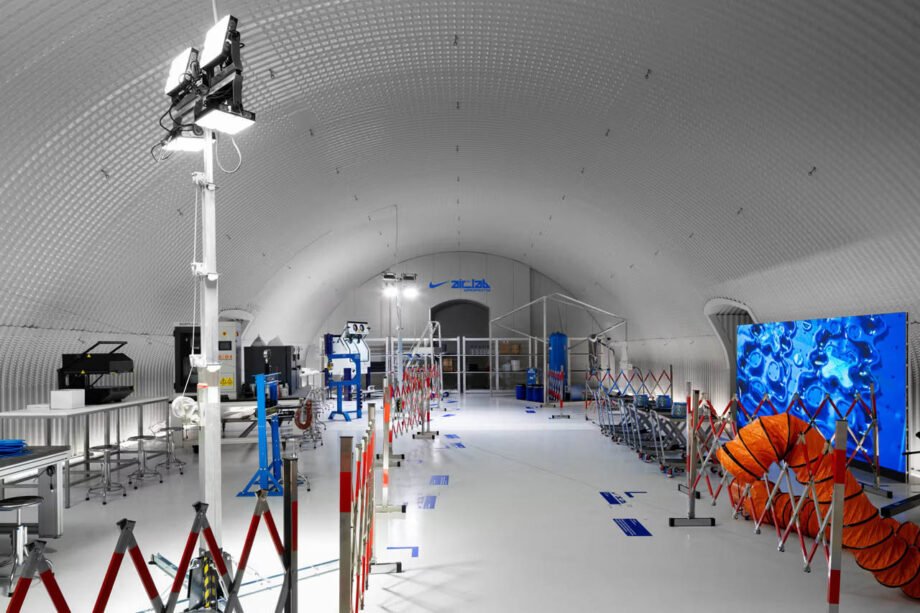
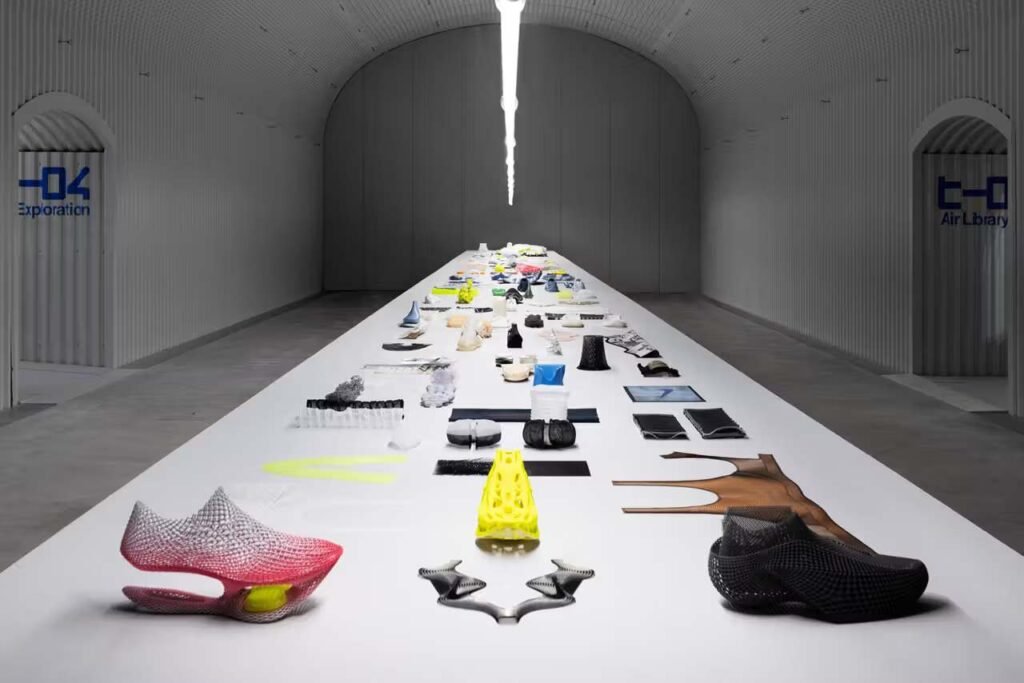
Nike’s presence at Milan Design Week centers on Nike Air Lab, an installation focused on experimentation, prototyping, and designer collaboration.
Rather than showcasing finished products, the space highlights:
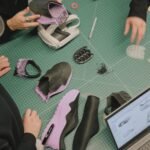
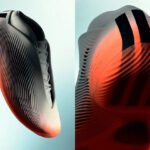
- Early-stage 3D printed Air Max prototypes
- Designer-led iterations developed in short cycles
- A controlled environment for testing form, structure, and material behavior
The lab operates less like a retail activation and more like a design infrastructure layer, where concepts are refined before entering traditional product pipelines.
This positions Nike’s additive efforts as continuous development rather than event-driven experimentation.
Nike 3D Printed Air Max as a Prototype System
The Nike 3D printed Air Max concept is not presented as a finalized consumer product. Instead, it functions as a modular prototype system.
Key characteristics include:
- Iterative design cycles enabled by additive manufacturing
- Structural experimentation without reliance on molds
- Rapid adjustments to geometry, cushioning, and upper integration
Nike’s reported collaboration with Zellerfeld reinforces this direction. Zellerfeld’s production model is built around fully printed footwear, aligning with Nike’s need for flexible prototyping.
This setup allows Nike to explore variations that would be impractical under traditional manufacturing timelines.
From Concept Showcase to Design Infrastructure
Milan Design Week has historically been used to present concept-driven work. Nike’s approach moves closer to process transparency.
Instead of presenting a single “future shoe,” the lab exposes:
- The scale of experimentation (reportedly 100+ prototypes)
- Variability across design outcomes
- The role of additive manufacturing in early-stage development
This suggests a shift from storytelling to system-building.
The practical implication is that additive manufacturing is being positioned as a tool for internal iteration, not just external visibility.
How Nike Air Lab Reflects Additive Footwear Direction
The Nike Air Lab aligns with broader industry movement, where additive manufacturing reduces development friction.
Compared to traditional workflows:
- Tooling constraints are minimized
- Design changes do not require production resets
- Prototyping cycles become shorter and more frequent
However, this does not automatically translate into scalable retail products.
A practical clarification: faster prototyping improves development speed, but mass production constraints still apply, particularly around cost and consistency.


What This Means for 3D Printed Footwear
Nike’s Air Lab indicates that the role of 3D printing in footwear is stabilizing around design efficiency, not immediate mass-market replacement.
Implications include:
- Additive manufacturing is becoming a backend system, not just a visible innovation
- Brands are investing in iteration capability, not only final products
- Collaboration with specialized companies like Zellerfeld is increasing
The key shift is structural: the value is moving from the product itself to the process behind it.
A grounded takeaway: while 3D printed footwear draws attention for customization, its near-term impact is more likely in reducing development cycles than replacing traditional manufacturing.
Limitations and Open Questions
Despite the scale of experimentation, several constraints remain:
- Production scalability — transitioning from prototypes to consistent output
- Material limitations — balancing durability, flexibility, and comfort
- Cost efficiency — higher per-unit cost compared to traditional methods
- Consumer readiness — limited exposure to fully printed footwear
Each factor affects whether Nike 3D printed Air Max concepts can move from lab environments to commercial availability.
Practical clarification: a successful prototype does not ensure retail viability without cost alignment and durability validation.
What to Watch Next
Key developments to monitor:
- Movement from lab prototypes to limited retail releases
- Expansion into performance footwear categories
- Deeper integration of partners like Zellerfeld
- Evidence of repeatable production systems, not just design variation
The next phase will be defined by whether these systems produce consistent, purchasable products at scale.
Mini FAQ
Nike Air Lab is an experimental space showcasing 3D printed Air Max prototypes and additive footwear design processes.
Not yet. Current work focuses on prototyping and development systems rather than confirmed retail products.
Additive manufacturing allows faster design iteration, testing, and structural experimentation compared to traditional methods.