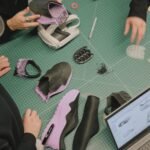
Fitasy has added single shoe ordering to its platform for custom 3D printed shoes, giving customers the option to buy only a left or right shoe instead of a full pair. For people searching “Can I buy only one custom shoe?”, the update points to a practical shift in how personalized footwear can be produced and sold.
Fitasy Updates Its On-Demand Footwear Platform
Fitasy, a custom-fit 3D printed footwear company, has introduced the ability to purchase an individual shoe directly through its website. The option is designed for customers who only need one shoe, including some prosthetic users and people with asymmetrical footwear needs. (3D Printing Industry)
The single-shoe option is priced at exactly half the cost of a full pair, rather than being handled as a special request or custom exception. That pricing structure matters because traditional footwear retail is built around manufacturing, stocking, and selling shoes in pairs.
For Fitasy, the update is not simply a product-page feature. It reflects a different production model, where each shoe can be created independently using digital foot data and additive manufacturing instead of fixed inventory.
Custom 3D Printed Shoes Move Beyond Standard Pairs
The main development is that custom 3D printed shoes can now be ordered as individual units through Fitasy’s platform. In conventional footwear, selling one shoe often creates an inventory problem because the retailer may need to split a pair and absorb the cost of the unused shoe.
Fitasy’s model avoids part of that issue because the shoe is not pulled from a pre-made stockroom pair. It is produced through a scan-to-print workflow, where the customer’s foot data informs the final shape and fit.
According to Fitasy’s earlier product explanation, its system uses smartphone-based foot capture, spatial AI, imaging, and 3D printing to create footwear based on individual foot morphology. The company describes the process as a scan-to-print workflow designed around the actual shape of the customer’s foot, not only a standard size label. (Fitasy)
That makes single shoe ordering more practical because each shoe is already treated as its own digitally defined product.
How the Single Shoe Ordering Model Works
Fitasy’s update allows customers to select only the left or right shoe when they do not need a complete pair. The company says the option is aimed at people who require one shoe, including those who use prosthetics. (TCT)
The basic model is straightforward:
- The customer orders only the needed side.
- The shoe is priced at half the cost of a pair.
- The footwear is produced through Fitasy’s custom-fit system.
- The model avoids splitting existing inventory.
This is the key difference from traditional single-shoe sales. Some retailers have experimented with selling one shoe, but those systems often depend on separating a pre-made pair. That can create waste, stranded inventory, or internal cost absorption.
Fitasy’s approach is cleaner from a manufacturing perspective because the product is made on demand. The company does not need to start with two shoes if the customer only needs one.
Why Prosthetic Footwear Is a Practical Test Case
The update is especially relevant for prosthetic footwear because some customers may only use one conventional shoe in specific activities. Paralympian Stef Reid’s “one-shoe campaign” helped frame the issue publicly, with Fitasy citing her advocacy as inspiration for the single-shoe option. (PR Newswire)
This is where the story becomes more than a niche product update. Footwear is usually designed around an average customer who buys and wears matched pairs. That model does not work equally well for people whose footwear needs fall outside that assumption.
For prosthetic users, the issue is not only fit. It can also be cost and waste. Buying two shoes when only one is needed means paying for an unused product.
Fitasy’s single shoe ordering does not solve every prosthetic footwear challenge. It does, however, show how custom fit footwear can respond to a specific use case that mass production often handles poorly.
What This Means for 3D Printed Footwear
The larger implication is that 3D printed footwear is beginning to show value beyond unusual designs or limited sneaker drops. Fitasy’s update highlights a practical advantage of digital production: the ability to make footwear in smaller, more specific units without relying on bulk inventory economics.
This is important because much of the public conversation around 3D printed shoes still focuses on novelty. Single shoe ordering is less flashy, but it may be more meaningful for everyday adoption.
The real signal is flexibility. If a company can economically produce one left shoe, one right shoe, or two different shoe geometries for the same customer, the footwear model becomes more adaptable than traditional sizing.
That does not mean standard shoe sizes disappear immediately. Most consumers still buy conventional shoes because they are cheaper, familiar, widely available, and easy to return. But Fitasy’s update shows where custom production can compete: cases where standard retail creates friction, waste, or poor fit.
In practical terms, this is not about replacing every sneaker on the shelf. It is about serving customers whose needs are poorly matched by that shelf.
What Is Not Solved Yet
Fitasy’s update is meaningful, but it should not be overstated.
First, custom 3D printed footwear still depends on consumer trust. Customers need to believe the scan, fit, comfort, durability, and return process will work before they choose it over familiar footwear options.
Second, price remains a factor. Even with single shoe pricing at half the cost of a pair, custom production may still feel premium compared with mass-market footwear.
Third, performance expectations are not uniform. A shoe that works for recovery, casual wear, or daily support may not automatically meet the demands of running, court sports, or long-distance use.
Fourth, accessibility is broader than ordering flexibility. Prosthetic users may need different outsole behavior, weight distribution, heel structure, or activity-specific support. A single-shoe option helps with access and waste, but it does not automatically address every biomechanical requirement.
The practical clarification is simple: this is a useful production and retail update, not a universal footwear solution.
What to Watch Next
The next question is whether single shoe ordering becomes a broader category feature or remains a Fitasy-specific differentiator.
Several developments would make this story more important:
- More customer data from prosthetic users and one-shoe buyers
- Clearer information about comfort and durability over time
- Expansion into different activity types, such as walking, recovery, or work footwear
- Wider adoption of single-shoe ordering by other custom footwear platforms
- Better retail education around smartphone scanning and personalized fit
The strongest signal to watch is whether customers treat single shoe ordering as a real purchasing option, not just an inclusive headline. If repeat demand develops, it would support the case that custom 3D printed shoes can solve practical problems that traditional shoe retail was never built to handle.
Mini FAQ
Yes. Fitasy now allows customers to order only the left or right shoe instead of buying a full pair.
Some prosthetic users may only need one conventional shoe. Single shoe ordering can reduce waste and avoid the cost of buying an unused second shoe.
No. Fitasy uses a made-to-order model based on digital foot data, which makes individual shoe production more practical than traditional retail inventory.