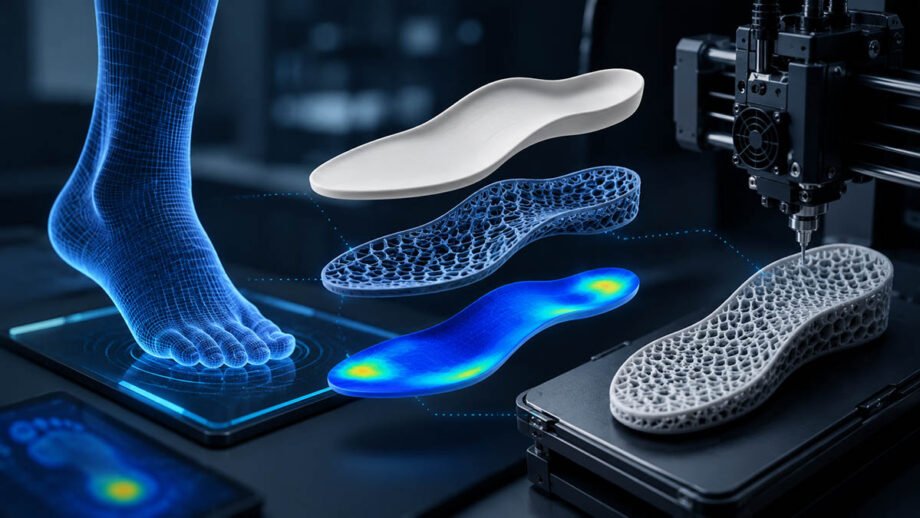
Artificial intelligence is increasingly being applied to footwear design, but can it meaningfully reduce the time required to create personalized orthotic devices? New research suggests AI custom foot orthoses could automate much of the design process by combining generative AI, biomechanical simulation, and 3D printing into a single workflow, marking an important development for digital footwear manufacturing.
Research Credit
This article is based on the peer-reviewed preprint “A Research Prototype for Closed-Loop Generative Design of Customized Foot Orthoses via Semantic-Physics Alignment” by Rui Wang, Byungwon Min, and Suxing Liu, published as an arXiv preprint.
TANS-FO Introduces a New Workflow for Personalized Orthotic Design
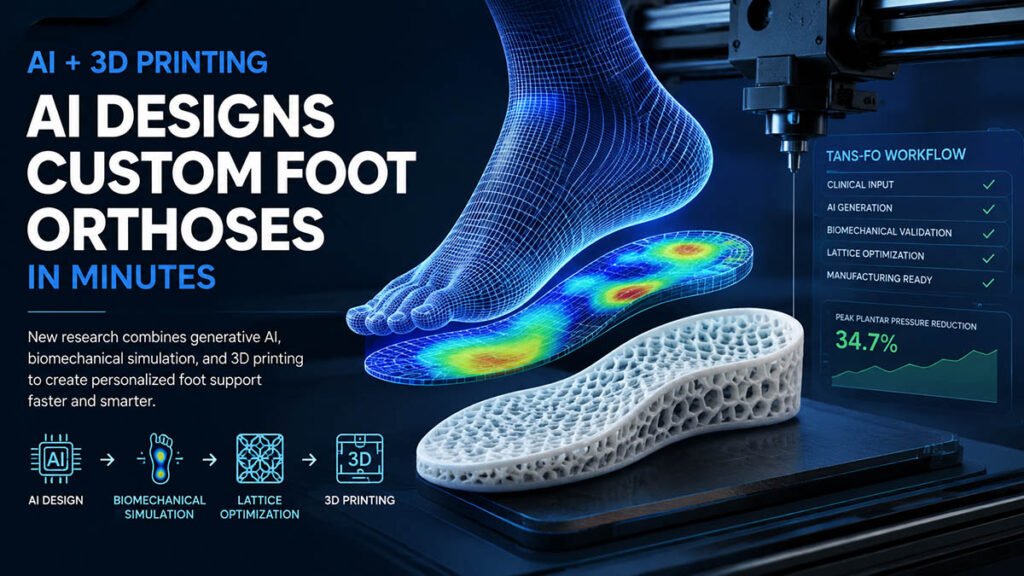
Researchers have unveiled TANS-FO, a research prototype designed to automate the creation of customized foot orthoses through a closed-loop generative design pipeline. Unlike conventional CAD workflows that rely heavily on manual adjustments by specialists, TANS-FO interprets clinical prescriptions and converts them into manufacturing-ready orthotic designs within minutes.
The system combines several technologies into one process:
- AI models that interpret clinical descriptions
- Anthropometric foot data from the PicoFoot-5K database
- Physics-informed biomechanical simulation
- Automated lattice generation
- Manufacturing-ready 3D models
Rather than treating design and biomechanical validation as separate tasks, the workflow continuously evaluates each generated design before producing the final orthosis.
AI Custom Foot Orthoses Combine Generative Design With Biomechanical Validation
Traditional 3D printed foot orthoses often require multiple iterations between scanning, CAD modeling, simulation, and manufacturing. TANS-FO aims to shorten that cycle by introducing a feedback loop that keeps refining the design until it satisfies predefined biomechanical objectives.
One of the system’s key innovations is its Text-Aligned Neural Surrogate (TANS), which translates written clinical intent into geometric design parameters. A Graph Neural Network then estimates plantar pressure in real time, reducing dependence on computationally intensive finite element analysis during every design iteration.
According to the researchers, the prototype demonstrated:
- Manufacturing-ready lattice orthoses generated within minutes
- Agreement with reference finite element simulations (R² = 0.94)
- Up to a 34.7% reduction in predicted peak plantar pressure compared with conventional parametric CAD
- Average anatomical fit error of approximately 0.42 mm under the evaluated conditions
How Generative Design Footwear Research Could Change Orthotic Manufacturing
The significance of this research extends beyond a faster design process.
Current orthotic production frequently depends on experienced technicians manually interpreting prescriptions and adjusting CAD models. Automating those repetitive steps could improve consistency while allowing clinicians to spend more time evaluating patients rather than editing digital geometry.
Because the system generates lattice orthoses, designers can locally modify stiffness, cushioning, and structural support without redesigning an entire device. That flexibility aligns well with additive manufacturing, where internal structures can be customized for each individual.
Practical clarification: the study demonstrates a design-support workflow for customized orthoses. It does not show that AI independently replaces clinical decision-making.
What This Means for 3D Printed Footwear
Although TANS-FO focuses on orthotic devices rather than complete shoes, the underlying technologies are highly relevant to the future of personalized foot support and 3D printed footwear.
Many footwear companies are already investing in:
- Smartphone foot scanning
- Personalized midsoles
- Variable-density lattice structures
- On-demand additive manufacturing
Research like TANS-FO demonstrates how these technologies could eventually be connected into a single digital workflow, where clinical or biometric information informs automated product design before manufacturing begins.
In the long term, similar approaches could support the development of personalized midsoles, performance footwear, or medical-grade footwear that adapts to an individual’s anatomy rather than relying on standardized sizing.
Practical clarification: this paper presents an enabling design methodology, not evidence that commercial footwear manufacturers are currently deploying this exact workflow.
Limitations Show the Technology Is Still in Its Early Stages
The researchers are careful to position TANS-FO as a research prototype, not a clinically validated therapeutic system.
Several important limitations remain:
- Regulatory approval has not been pursued.
- Human review remains mandatory before manufacturing.
- Biomechanical validation focuses primarily on standardized quasi-static loading rather than full walking dynamics.
- The exploratory user observation involved only 12 participants, had no control group, and should not be interpreted as evidence of clinical effectiveness.
Practical clarification: patients should not view this as an available clinical product today. The research demonstrates technical feasibility rather than proven medical outcomes.
What to Watch Next
Future work will likely focus on expanding the system beyond static loading conditions toward full gait-cycle analysis and larger clinical studies.
Other areas to watch include:
- Integration with smartphone foot scanning
- Faster AI-assisted biomechanical simulation
- Commercial CAD platforms adopting similar automation
- Regulatory pathways for AI-assisted orthotic design
- Translation of generative orthotic workflows into customized 3D printed footwear
Whether these technologies ultimately reach mainstream footwear manufacturing will depend not only on advances in AI but also on clinical validation, manufacturing scalability, and regulatory acceptance. For now, TANS-FO provides an early look at how intelligent design systems may reshape the production of customized orthoses and, potentially, future generations of personalized footwear.
Mini FAQ
What are AI custom foot orthoses?
AI custom foot orthoses are personalized orthotic devices designed with artificial intelligence using clinical data, biomechanical analysis, and additive manufacturing workflows.
What is TANS-FO?
TANS-FO is a research prototype that automates customized foot orthosis design through semantic AI, biomechanical simulation, and lattice optimization. It is not a commercially available medical device.
Is TANS-FO available for patients?
No. The researchers describe TANS-FO as an experimental research system intended to demonstrate a new design workflow rather than a clinically validated therapeutic solution.
Sources & Credits
Primary Research
Wang, R., Min, B., & Liu, S. (2026). A Research Prototype for Closed-Loop Generative Design of Customized Foot Orthoses via Semantic-Physics Alignment. arXiv.
Read the original paper: https://arxiv.org/abs/2607.16631
Authors:
- Rui Wang
- Byungwon Min
- Suxing Liu
Editorial Note: This article is an independent editorial summary of the research cited above. Technical findings and performance metrics are based on the authors’ published manuscript. Analysis and interpretation are provided by the 3DShoes.com editorial team.
Disclosure: 3DShoes.com has no affiliation with the authors or their institutions and received no compensation related to this coverage.