3D Shoes 3D Shoes
  • News
    NewsShow More
    A close-up of a modern 3D printer creating a small figurine, representing digital manufacturing and copyright issues.
    3D Printing and Copyright: When Does Making a Replica Become a Crime?
    November 9, 2025
    Hajin Kim-Tackowiak (MIT) at the Autodesk Technology Center in Boston.
    MIT & Autodesk: How 3D‑Printed Concrete Is Rewriting Bridge Design — and What Footwear Makers Can Learn
    November 7, 2025
    A realistic photo of a prosumer 3D printer creating a detailed part on a modern workbench in a bright studio.
    Inside the 2025 3D Printing Boom: Why Prosumer Printers Are Outselling Industrial Models — and What It Means for Footwear Innovation
    October 31, 2025
    Futuristic 3D-printed shoes made from photochromic materials that change color under sunlight, showcasing smart fashion innovation.
    Color-Changing 3D-Printed Shoes? Scientists Create Light-Responsive Materials That Think
    October 22, 2025
    UW–Platteville professors turn spoiled milk into biodegradable plastic for 3D printing(WMTV)
    Spoiled Milk to 3D Printing: UW-Platteville’s Biodegradable Plastic Breakthrough
    October 19, 2025
  • Design
    DesignShow More
    A close-up of a modern 3D printer creating a small figurine, representing digital manufacturing and copyright issues.
    3D Printing and Copyright: When Does Making a Replica Become a Crime?
    November 9, 2025
    Nike A.I.R dragon-scale 3D-printed sprint spike prototype
    AI 3D Printing: How Smart Machines Are Reinventing Footwear—from Design to Delivery
    July 16, 2025
    adidas Is Dropping A Laced Version Of The Climacool
    Adidas Climacool Laced 2025 Release: What You Need to Know Before Buying
    June 20, 2025
    Side profile of the red 3-D-printed Nike Air Max 1000 prototype
    Nike Air Max 1000 vs Adidas 4DFWD 3: Can Either 3‑D‑Printed Sneaker Survive 500+ Miles?
    June 16, 2025
    A pigmented O° shoe featuring a black 3D-printed structure overlaying a grey textile base layer Image: Courtesy of OXMAN
    OXMAN’s O° Platform: Pioneering 100% Biodegradable 3D-Printed Footwear
    January 29, 2025
  • Trends
    TrendsShow More
    Researchers in a university lab examining a 3D-printed chair made from recycled fishing nets using an industrial 3D printer, showcasing sustainable material innovation.
    From Ghost Nets to Gear: IISc’s Fast Recycling Turns Ocean Waste into 3D-Printable Nylon
    November 4, 2025
    Photo Credits: Courtesy of Carbon® and Hypsole — from the case study “Hypsole’s Cleat Guard Dream Gets to Production Faster with Carbon.”
    Hypsole’s 3D-Printed Cleat Guards: Redefining Off-Field Footwear with Carbon’s Digital Manufacturing
    October 24, 2025
    Credit: Shu Shu Zheng / RMIT University.
    Battery‑Free Implants? How RMIT’s 3D‑Printed Diamond–Titanium Device Generates Power Inside the Body
    October 4, 2025
    Isometric 3D-printer nozzle laying toolpath to build a lattice bracket; inset compares continuum vs discrete design.
    Toolpath-Aware Topology Optimization: How MIT’s Method Makes Complex 3D-Printed Parts More Reliable
    September 29, 2025
    EcoFil 3D student startup team receiving an award at the be’ah Tech incubator event in Oman.
    EcoFil 3D: The Student Startup Turning Kitchen Waste into Printer Filament
    September 27, 2025
  • Recommended Picks
    Recommended PicksShow More
    High-resolution collage featuring five popular running shoes — Nike Invincible 4, HOKA Bondi 9, ASICS GEL-Nimbus 27, New Balance FuelCell SC Elite v4, and Adidas 4DFWD — recommended for an EPU 45 midsole upgrade.
    5 Running Shoes That Need Carbon’s EPU 45 Foam (But Probably Won’t Get It Yet)
    June 10, 2025
    Anycubic Wash & Cure 3
    Budget vs. Premium: Which Wash & Cure Station Is Right for You in 2025?
    June 5, 2025
    CAD for kids course review covers a 16-week program taking learners from CAD sketch to 3D-printed model, summarizing projects, skills and required tools.
    CAD for Kids – Build, Create & Learn — Our Full Project-Based Review
    May 8, 2025
    Best Subscription Boxes for Moms This Mother’s Day (2025 Gift Guide)
    🎀 Best Subscription Boxes for Moms This Mother’s Day (2025 Gift Guide)
    April 29, 2025
    3D Printing from Zero to Hero in Blender – FDM & MSLA - Course Review
    3D Printing from Zero to Hero in Blender – FDM & MSLA: Build, Create & Learn — Our Full Project-Based Review
    April 12, 2025
Reading: Startup advised by ex-Nike execs cuts shoe footprints through 3D printing
Fuel Our Steps
Font ResizerAa
3DSHOES.COM3DSHOES.COM
  • News
  • Design
  • Recommended Picks
  • STL Files
Search
  • Home
  • News
  • Design
  • Recommended Picks

Various 3D Applications

R_Shoes R_Shoes June 26, 2024
5.9kLike
4kFollow
3.7kPin
3.7kFollow
  • Home
  • About
  • STL Files
  • Contact
© 2024 3DSHOES.com. All Rights Reserved.
News

Startup advised by ex-Nike execs cuts shoe footprints through 3D printing

R_Shoes
Last updated: June 27, 2024 1:45 am
By R_Shoes 7 Min Read
Share
SHARE

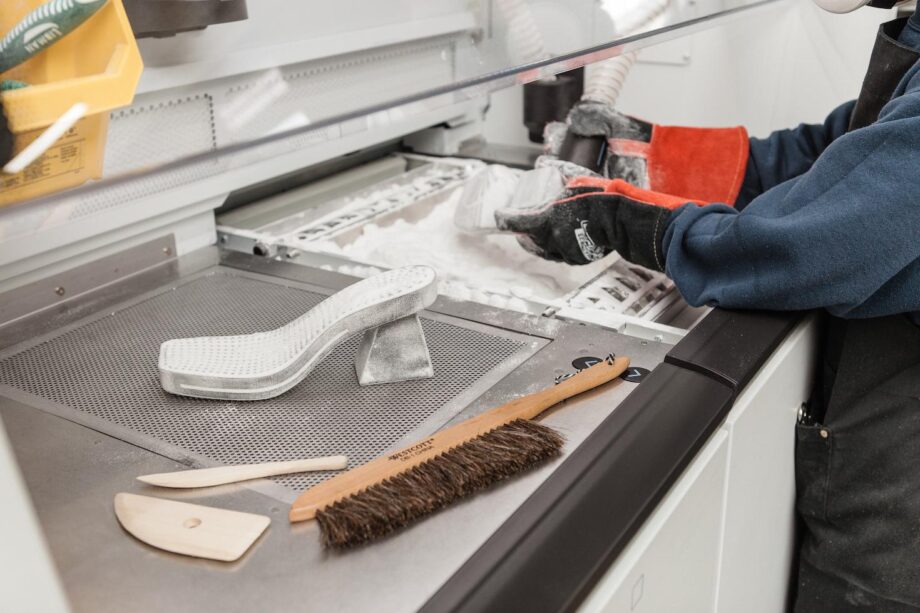
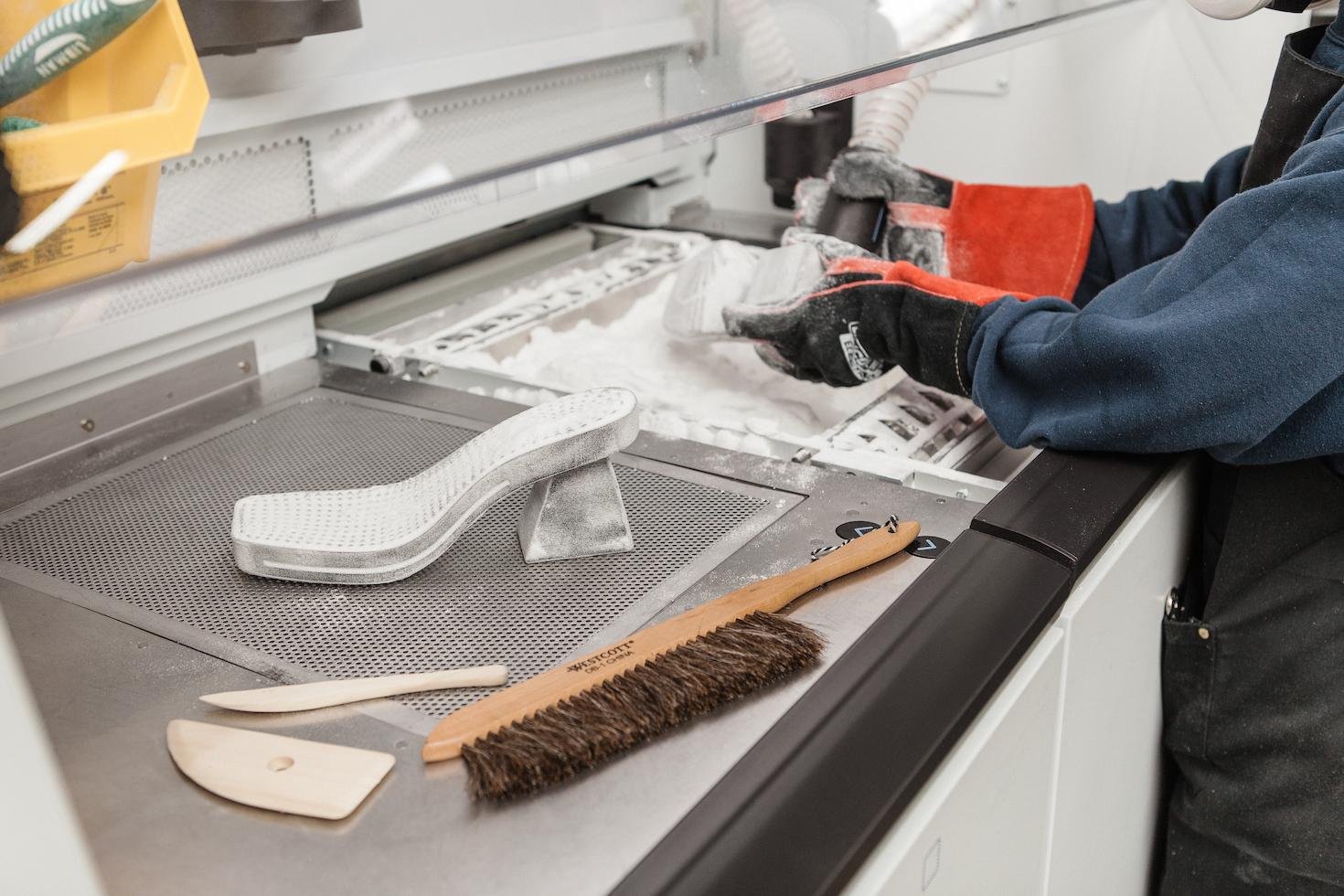
Hilos makes the platform for mules, clogs and sandals using 3D printing technologies. Image courtesy of Hilos/Nicholas Peter Wilson


How many shoes live in your closet? I stopped counting at 30 pairs, although in my defense, I’ve been wearing and repairing some of them for two decades.

Setting aside my questionable consumer habit, these official shoe stats are even more concerning: Of the estimated 20 billion to 24 billion pairs of footwear produced annually on a global basis, a significant number of them — potentially 95 percent — eventually walk their way into landfills. That number looms large for circular economy entrepreneur Elias Stahl, CEO and co-founder of three-year-old startup Hilos, which uses 3D printing technologies to produce the “platform” for shoes as they are ordered. (As Stahl tells it, the name “represents the versatility of the technology, from highs to lows.”)

Stahl, most recently vice president of products for social impact agency Handshake Partners, said he was motivated by the “insane amount” of waste he has observed in traditional manufacturing models. Many machines for shoe and apparel production, Stahl notes, haven’t been redesigned in a century — he describes them as “the last gasp” of U.S. product consumption models built on cheap overseas labor and a relative disregard for waste. “This is too big of a problem not to solve,” he told me.

Hilos, based in Portland, Oregon, in March raised $3 million in early funding for its process to rewrite the rules for shoe production using 3D printing technologies — a model already being used by shoemaker Helm to make bespoke mules that retail for $225 per pair. (Not exactly a mainstream offering.) Its investors include two former executives from Nike: Eric Sprunk, retired COO; and Greg Bui, retired vice president of global footwear sourcing and manufacturing. Both are actively engaged with Hilos — Bui is leading “a rapid scale-up of the technology” (according to the company’s public statements) and Sprunk is an adviser. 

Allure of additive manufacturing

Hilos is using 3D printing to change how the platform of a shoe — the part that bears the brunt of your personal footprint and, for that matter, the carbon one — is created and how it can be attached to the “upper” portion. It doesn’t own the printers outright, instead, it partners with GKN Additive, using its facilities in California and Michigan, Stahl told me. Rather than being assembled from multiple layers glued or cemented together, the Hilos “printed” platform is created as one part that combines insole, midsole, outsole and heel. Because of how this component is designed by Hilos, the “upper” of the shoe — in the case of the aforementioned mules, it’s veg-tanned leather — can be attached using cables. (A unique approach.) According to Stahl, there are a number of benefits to this approach (the data is from an analysis referenced a bit later in this essay):

  • The use of noxious glues is reduced, although it still uses about 1 gram per pair.
  • The number of parts required can be dramatically reduced from an average of 65 to just five components per shoe. The number of steps required for assembly is reduced from 360 down to 12. That means it takes about an hour of labor to assemble rather than the typical estimate of four hours.
  • The shoes can be produced “on demand” once they are ordered, cutting down on wasted inventory that never finds its way off the shelf. 
  • The shoes are easier to disassemble at the end of their wearable life.  

Hilos teamed with the Yale University Center for Business and the Environment, BASF, HP and Additive Manufacturing Technologies to calculate the environmental impact analysis for its approach, the source for some of those claims. The startup also says its process can reduce the water consumption needed to produce a pair of shoes by up to 99 percent compared with traditional manufacturing, while reducing greenhouse gas emissions by 48 percent. About 29 percent of the CO2 reduction is related to parts reduction, 20 percent comes from switching to on-demand production and the rest comes from the product’s circularity, according to the analysis.  

By the way, the evaluation specifically compared the Helm Emmett mule design with the Veja Esplar sneaker, with a fully leather upper. 

One last thing to point out: If you compare the emissions of the two shoes on a part-by-part basis, the analysis suggests that the emissions for 3D printing are actually 10 percent to 17 percent higher. “Only when a complete assembly of the shoe is taken into account does the overall carbon efficiency of 3D printing stand out,” according to the analysis.   

There’s another factor to take into account: What the Hilos platform is made out of. It’s not necessarily a material an audience of sustainability professionals readers would consider sustainable over the long term — the substance is a thermoplastic polyurethane powder from BASF. (Hence, BASF’s participation in the analysis.) When I asked Stahl if Hilos plans to use recycled or bio-based materials to create its shoe platforms, he replied that Hilos is actively exploring and developing material solutions in this direction.

Does Hilos represent a turning point for the use of additive manufacturing in the fashion industry? That’s clearly for brands to decide, as the startup pitches its approach — I can imagine it working mainly for some really specific footwear. But given those advising its business model, this startup is taking a step in the right direction.

Editor’s note: This article was updated April 19 to clarify the company’s future focus on materials and how the shoes can be assembled.  


SOURCE: https://www.greenbiz.com/article/startup-seeks-cut-shoe-footprints-through-3d-printing
Share This Article
Facebook Twitter Copy Link

Stay Up To Date!

Sign up for 3DShoes.com's mailing list where you will stay up-to-date with latest trends, drops, and more.

loader

Trending

Bambu Lab MakerWorld Crowdfunding: How the New Kickstarter-Style Platform Super-Charges 3D-Printing Projects

The biggest bottleneck in desktop 3D printing isn’t creativity—it’s cash flow. Complex builds need prototype after…

August 4, 2025

Koobz Raises $7.2 Million: How an 800‑Printer “Sneaker Factory” Could Kick‑Start the 3D‑Printed Footwear Revolution

Introduction — From Garage Startup to High‑Tech Footwear PowerhouseTwo years ago mechanical‑engineer‑turned‑founder Kuba Graczyk was squeezing lattice sneaker…

June 25, 2025

Glue-Free, Bold, and Global: The Rise of Daniyar Uderbekov’s 3D-Printed Shoes

Introduction: Innovation, Heritage, and the Future of FootwearWhat happens when nomadic heritage meets additive manufacturing?…

September 8, 2025
PixelCrafted banner ad bold headline ‘Websites That Sell’, tagline ‘Custom WordPress builds that convert’, button ‘Get a Free Mockup’.
5.9kLike
4kFollow
3.7kPin
3.7kFollow
Innovation & Trends

From Ghost Nets to Gear: IISc’s Fast Recycling Turns Ocean Waste into 3D-Printable Nylon

Researchers in a university lab examining a 3D-printed chair made from recycled fishing nets using an industrial 3D printer, showcasing sustainable material innovation.

A new process from the Indian Institute of Science transforms discarded fishing nets into high-performance PA-66 nylon — strong enough for industrial 3D printing and potentially rigid footwear components.

R_Shoes November 4, 2025

Your may also like!

A close-up of a modern 3D printer creating a small figurine, representing digital manufacturing and copyright issues.
DesignNews

3D Printing and Copyright: When Does Making a Replica Become a Crime?

R_Shoes November 9, 2025
Hajin Kim-Tackowiak (MIT) at the Autodesk Technology Center in Boston.
News

MIT & Autodesk: How 3D‑Printed Concrete Is Rewriting Bridge Design — and What Footwear Makers Can Learn

R_Shoes November 7, 2025
Researchers in a university lab examining a 3D-printed chair made from recycled fishing nets using an industrial 3D printer, showcasing sustainable material innovation.
Innovation & Trends

From Ghost Nets to Gear: IISc’s Fast Recycling Turns Ocean Waste into 3D-Printable Nylon

R_Shoes November 4, 2025
A realistic photo of a prosumer 3D printer creating a detailed part on a modern workbench in a bright studio.
News

Inside the 2025 3D Printing Boom: Why Prosumer Printers Are Outselling Industrial Models — and What It Means for Footwear Innovation

R_Shoes October 31, 2025
loader

Our website stores cookies on your computer. They allow us to remember you and help personalize your experience with our site.

Read our privacy policy for more information.

Quick Links

  • Home
  • About
  • STL Files
  • Contact

Legal

  • Privacy Policy
  • Cookie Policy (EU)
  • Disclaimer
  • Terms & Conditions

Socials

Follow US
Crafted with love by PixelCrafted.Dev ❤
Manage Consent
To provide the best experiences, we use technologies like cookies to store and/or access device information. Consenting to these technologies will allow us to process data such as browsing behavior or unique IDs on this site. Not consenting or withdrawing consent, may adversely affect certain features and functions.
Functional Always active
The technical storage or access is strictly necessary for the legitimate purpose of enabling the use of a specific service explicitly requested by the subscriber or user, or for the sole purpose of carrying out the transmission of a communication over an electronic communications network.
Preferences
The technical storage or access is necessary for the legitimate purpose of storing preferences that are not requested by the subscriber or user.
Statistics
The technical storage or access that is used exclusively for statistical purposes. The technical storage or access that is used exclusively for anonymous statistical purposes. Without a subpoena, voluntary compliance on the part of your Internet Service Provider, or additional records from a third party, information stored or retrieved for this purpose alone cannot usually be used to identify you.
Marketing
The technical storage or access is required to create user profiles to send advertising, or to track the user on a website or across several websites for similar marketing purposes.
Manage options Manage services Manage {vendor_count} vendors Read more about these purposes
View preferences
{title} {title} {title}
Stay Up To Date!

Sign up for 3DShoes.com's mailing list where you will stay up-to-date with latest trends, drops, and more.

loader

Zero spam, Unsubscribe at any time.
adbanner
AdBlock Detected
Our site is an advertising supported site. Please whitelist to support our site.
Okay, I'll Whitelist
Welcome Back!

Sign in to your account

Lost your password?