

Alexander Wang has launched a 3D printed stiletto called Griphoria, developed with Carbon and HILOS as a wearable luxury heel rather than a runway-only experiment. But can 3D printing solve one of footwear’s hardest commercial problems: making a thin high heel structurally reliable, wearable, and production-ready?
The launch signals a shift in additive footwear from sneakers and comfort slides toward more complex fashion categories, where structure, finish, and brand positioning matter as much as material innovation.
Alexander Wang Brings Griphoria Into Luxury Heel Design
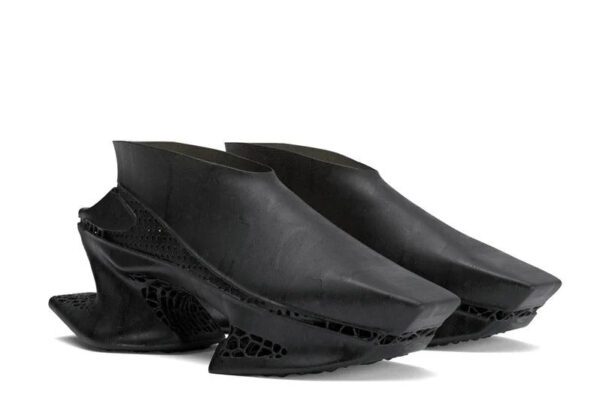
Alexander Wang’s Griphoria is a stiletto mule designed with a pointed silhouette, lug sole, and integrated detailing. The shoe is positioned as a luxury product, not simply a concept sample or technology demonstration.
That distinction matters. Many 3D printed shoes have appeared as prototypes, limited experiments, or sneaker-adjacent products. A stiletto creates a different engineering challenge because the heel must carry concentrated load through a narrow structure.
The Griphoria was developed with Carbon and HILOS and has been described as a wearable 3D printed stiletto. Its development also points to a longer-term effort to move additive manufacturing into finished luxury footwear.
The practical point is clear: this is not just about printing a dramatic shape. The product has to meet luxury footwear expectations around stability, finish, sizing, wearability, and retail presentation.
How the 3D Printed Stiletto Is Built
The 3D printed stiletto uses Carbon’s Digital Light Synthesis technology and the HILOS design and production platform. The shoe is described as engineered for durability and comfort using Carbon 3D printer technology and HILOS footwear production tools.
Earlier reporting on the project describes a duo-print construction using two Carbon materials:
- EPU 46 for the upper and insole
- RPU 70 for the rigid heel
- Lattice structures for cushioning and variable support
- A printed construction that reduces reliance on traditional molds
This construction matters because high heels are not forgiving products. The upper must flex, the footbed must support pressure points, and the heel must remain rigid under load.
In practical terms, the shoe separates flexibility and structure by material zone. That allows the design to behave more like a finished footwear product instead of a single-material printed shell.
Carbon 3D Printed Shoes Move Beyond Sneakers
Carbon is already closely associated with performance-oriented Carbon 3D printed shoes, particularly through adidas’ 3D printed midsole work. Griphoria extends that manufacturing story into luxury fashion rather than athletic cushioning.
That shift is notable because sneakers have been the safer category for additive footwear. Their midsoles offer a natural use case for lattices, cushioning, and controlled compression.
A stiletto is different. It has less surface area, higher structural concentration, and stricter aesthetic expectations.
For Carbon, the project shows how Digital Light Synthesis can support footwear applications where visual finish and structural performance need to coexist. For luxury brands, it suggests additive manufacturing may be useful not only for prototypes, but for selectively produced commercial footwear.
Why HILOS Footwear Matters in the Griphoria Launch
HILOS plays a different role from a traditional factory or design collaborator. Its platform is focused on digital footwear workflows, including design, development, and production systems that reduce dependence on conventional tooling.
That matters because luxury footwear usually relies on complex supply chains, molds, sampling, material cutting, assembly, and finishing. HILOS footwear systems are positioned around more direct digital production, where geometry and manufacturing can be connected earlier in the design process.
For Griphoria, the relevant change is not simply that the shoe is 3D printed. It is that the production method supports a more integrated construction.
This does not mean every luxury heel can now be printed on demand at scale. It means one brand-backed product has reached a commercial stage using a digitally manufactured construction.
What This Means for 3D Printed Footwear
The Griphoria launch broadens the conversation around luxury 3D printed footwear. Until now, much of the consumer-facing attention has centered on performance shoes, recovery slides, and custom-fit casual footwear.
A 3D printed high heel changes the category signal. It suggests additive footwear is moving into products where the value proposition includes form, material control, limited production, and brand identity—not only comfort or sustainability.
The most important takeaway is that 3D printing is being used as a construction system, not just a visual effect. In practical terms, the technology allows the shoe to combine flexible and rigid zones while reducing the need for some conventional tooling.
Still, this is not proof of mass adoption. A luxury stiletto can succeed as a controlled, premium product while remaining far from everyday footwear economics.
Reality Check: What Is Not Solved Yet
Griphoria is an important release, but it does not remove the major barriers facing 3D printed high heels or broader printed footwear.
Several questions remain:
- How durable the shoe is across long-term, repeated wear
- Whether comfort claims hold up across different foot shapes
- How efficiently production can scale beyond limited demand
- Whether the cost structure can move below luxury pricing
- How repair, returns, and sizing exchanges are handled
The product’s reported $795 price point places it firmly in luxury territory, not mainstream footwear.
That price positioning is not a flaw by itself. It simply means Griphoria is better understood as a premium proof of commercial readiness than as a sign that 3D printed heels are ready for broad-market adoption.
What to Watch Next
The next signal to watch is whether Alexander Wang expands Griphoria beyond a single black mule silhouette. Additional colorways, revised heel heights, or wider sizing would suggest confidence in the production model.
It will also be worth watching whether Carbon and HILOS use the project as a reference point for other fashion collaborations. If more brands adopt similar workflows, the significance of Griphoria may shift from one product launch to a repeatable luxury footwear system.
The deeper question is whether additive manufacturing can keep moving from isolated statement pieces into structured product lines. Griphoria does not answer that completely, but it gives the industry a clearer case study to measure.
Mini FAQ
The Alexander Wang Griphoria is a luxury stiletto mule developed with Carbon and HILOS. It uses 3D printing to combine flexible and rigid zones in a wearable heel design.
Yes. Griphoria is positioned as a wearable 3D printed stiletto, using Carbon 3D printing technology and HILOS footwear production tools.
A 3D printed high heel shows how additive manufacturing can move beyond sneakers and slides. It also tests whether printed footwear can meet luxury expectations for structure, comfort, and finish.