Are custom fit 3D printed sandals moving from limited experiment to practical footwear product? Vivobarefoot’s new Tabi Gen 02 shows the company continuing to develop scan-to-print footwear through VivoBiome, its personalized footwear platform.
Vivobarefoot Advances Tabi Gen 02 Through VivoBiome
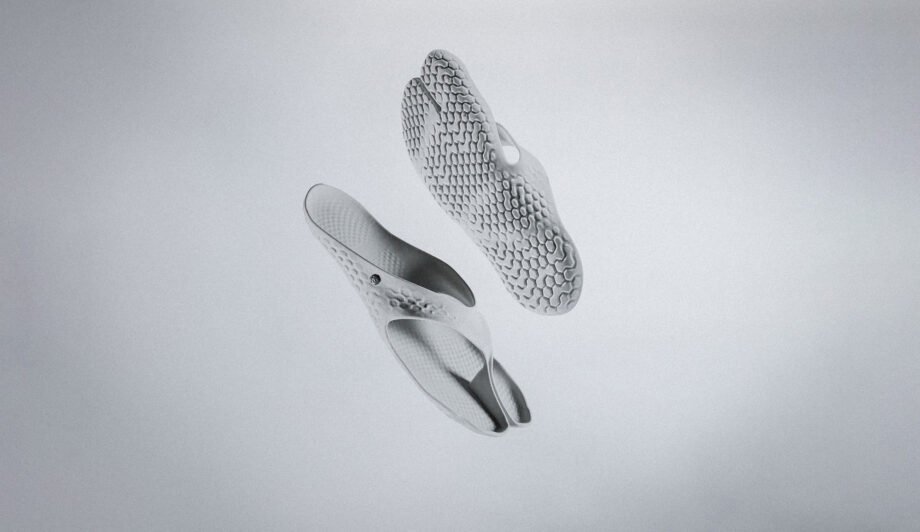
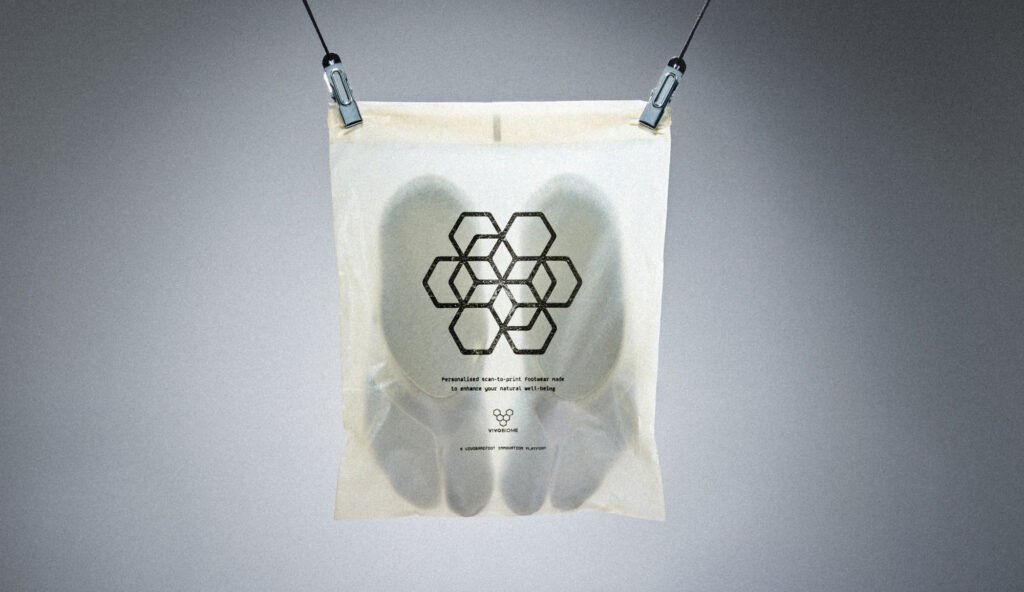
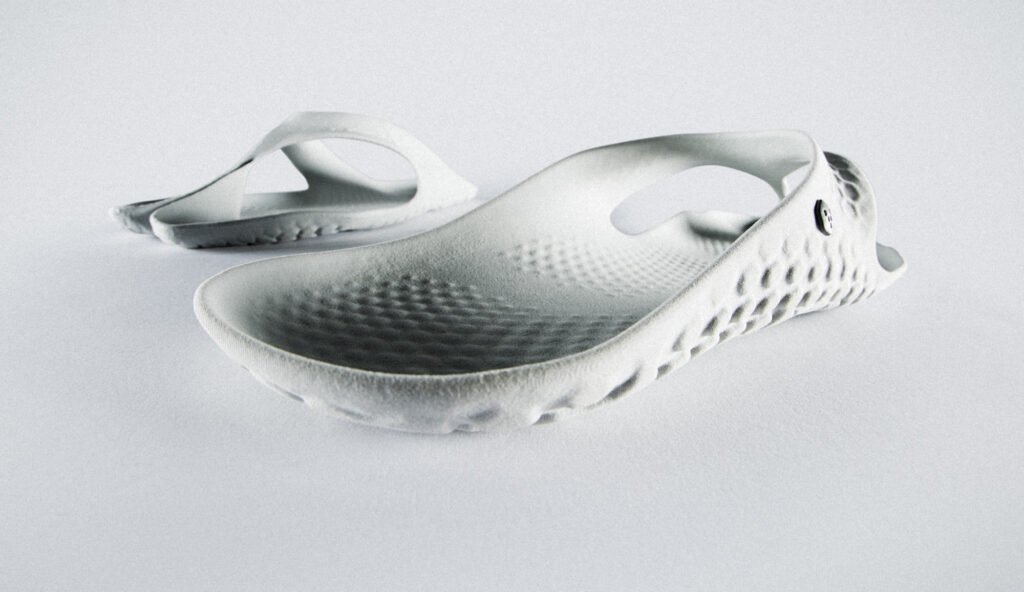
Vivobarefoot has introduced the Tabi Gen 02, the next version of its 3D printed barefoot sandal developed through VivoBiome, the company’s personalized scan-to-print footwear platform.
The release follows the Tabi Gen 01, which was produced in a limited run of 590 pairs. The new model keeps the split-toe sandal format but updates the production method, material system, and product positioning.
According to the source article, the Vivobarefoot Tabi Gen 02 is made using Carbon’s Digital Light Synthesis process in cooperation with OECHSLER, with Carbon BL6 PU foam used for the sandal structure.
For Vivobarefoot, the launch is less about entering the general sandal market and more about refining a made-to-measure footwear workflow.
How Custom Fit 3D Printed Sandals Work
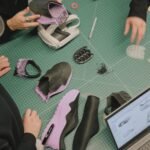
The custom fit 3D printed sandals process starts with a foot scan. Customers visit a Vivobarefoot store, step onto a scanner, save the scan under their email address, and later retrieve that scan online to complete the order.
From there, the sandals are produced around the customer’s foot shape rather than selected from a standard size range.
The practical difference is important:
- The product is shaped around the wearer’s scanned foot data.
- Production happens after the scan and purchase process.
- The model reduces reliance on traditional size inventory.
- Fit becomes part of the manufacturing system, not only the retail experience.
This makes the Tabi Gen 02 part of a broader scan to print footwear model, where the store becomes a data-capture point and manufacturing happens later.
What Changed From Tabi Gen 01
The Tabi Gen 01 established Vivobarefoot’s first public step into custom 3D printed barefoot sandals. That first version used in-store scanning and a limited production model.
Tabi Gen 02 appears to be a refinement rather than a complete repositioning. The profile remains similar, but Vivobarefoot has reportedly reduced weight while improving precision and comfort.
The larger change is technical. Gen 01 was previously reported as using SLS technology, while Gen 02 moves to Carbon’s DLS process.
That matters because production technology affects surface finish, material behavior, consistency, and how quickly future versions can be refined.
The VivoBiome website lists the Tabi Gen 02 as a unisex custom 3D printed product priced at £110, with Moonrock Grey shown as the available color. At the time referenced, the product page also showed the item as sold out.
Why VivoBiome Footwear Matters Beyond One Sandal
The VivoBiome footwear model points to a different way of thinking about barefoot shoes. Instead of designing around general size categories, Vivobarefoot is testing whether personalized shape data can become part of the product architecture.
That is especially relevant for barefoot footwear because fit, toe splay, flexibility, and ground feel are central to the category.
A poorly fitting minimalist sandal can create friction, instability, or toe-gripping behavior, even if the product is technically “barefoot” in design.
The practical clarification is simple: customization only matters if it improves the wearing experience. A foot scan does not automatically solve comfort, durability, traction, or long-term fit.
Still, the Tabi Gen 02 shows how custom 3D printed shoes may evolve through small, repeatable product cycles. Vivobarefoot is not launching a broad mass-market line here. It is continuing a controlled product experiment with real customers, real scans, and real production constraints.
What This Means for 3D Printed Footwear
The important signal is not only that Vivobarefoot made another sandal. It is that the company is continuing to connect scanning, made-to-order production, barefoot design, and 3D printing into one operating model.
For 3D printed footwear, this is where the category becomes more commercially serious. The technology is not being used only to create unusual shapes. It is being used to test whether footwear can be produced around individual data without relying on traditional size inventory.
That does not mean scan-to-print footwear is ready to replace standard shoes. It means brands are beginning to define where additive manufacturing may have the clearest use case: personalized products, limited runs, fit-sensitive categories, and designs that benefit from rapid iteration.
The limitation is scale. Store-based scanning, delayed fulfillment, material cost, production capacity, and consumer education all remain obstacles.
In practical terms, a customer still has to understand the process, get scanned, wait for production, and trust that the final sandal will fit better than a standard product.
Reality Check: What Is Not Solved Yet
The Tabi Gen 02 does not solve every challenge facing 3D printed barefoot sandals.
Several questions remain open:
- Can the scanning process become easier outside selected retail locations?
- Can production scale without losing the made-to-measure advantage?
- Will customers accept delayed ownership for better fit?
- How durable will the material system be across daily use?
- Can the product move beyond limited drops and early adopters?
These are not minor issues. Footwear is not only a design problem. It is also a logistics, comfort, sizing, retail, and behavior problem.
The clearest practical challenge is access. If customers must visit a store for scanning, the model remains geographically limited.
If remote scanning becomes accurate enough, the market could widen. That would also introduce a new layer of technical risk.
What to Watch Next
The next development to watch is whether Vivobarefoot expands scanning access beyond a limited store-based process. Wider access would make the VivoBiome model more commercially meaningful.
It will also be important to see whether future Tabi versions improve turnaround time, color options, durability data, and repeat-order simplicity.
A strong scan-to-print system should eventually make the second purchase easier than the first.
The broader industry question is whether custom fit 3D printed sandals can move from limited release to repeatable product category. Vivobarefoot’s Tabi Gen 02 does not answer that fully, but it gives the market another real test case to study.
Mini FAQ
Custom fit 3D printed sandals are sandals produced around individual foot data instead of standard size categories. In Vivobarefoot’s case, the process uses a foot scan before production.
The Vivobarefoot Tabi Gen 02 is a made-to-measure 3D printed barefoot sandal developed through VivoBiome. It uses a split-toe design and a scan-to-print production model.
Scan to print footwear starts with a digital foot scan. The scan data is then used to produce footwear shaped around the wearer’s foot, usually through an on-demand manufacturing process.