

What does it mean when a shoe can be downloaded instead of bought? Printable 3D shoes are moving toward a digital-production model, with Kyiv-based designer Sofia Rousinovich releasing footwear designs as STL files and printing instructions that users can manufacture themselves.
Sofia Rousinovich Turns Footwear Into Digital Design Files
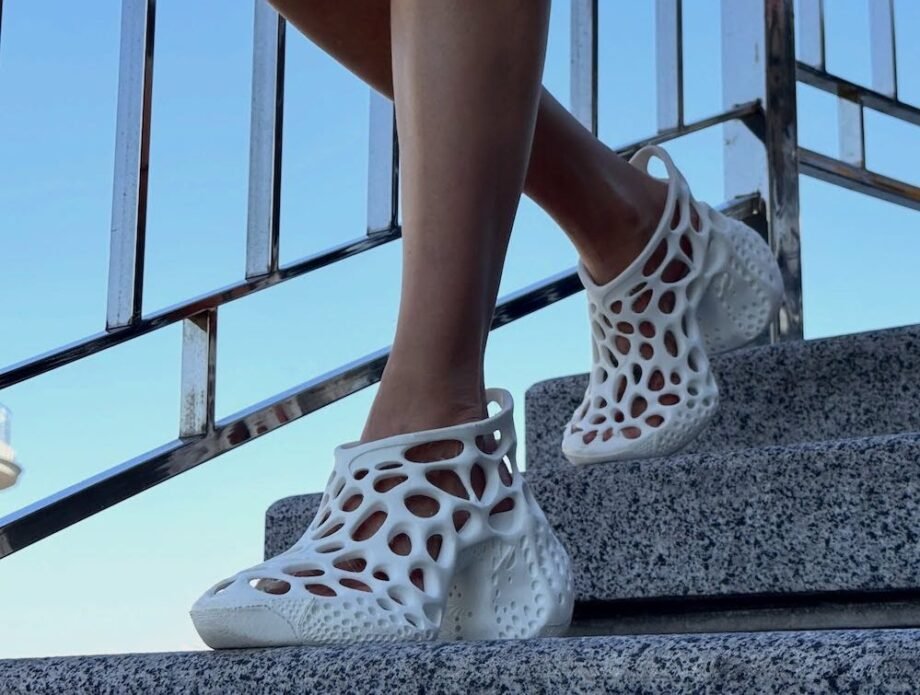
Rousinovich has released a collection of 3D-printable footwear that includes skeleton-inspired sandals, swan sandals, Voronoi heels and a more practical single-piece sandal. Rather than distributing finished footwear, the designs are offered as digital files and printing instructions.
The approach changes what the customer is buying. Instead of purchasing a finished pair of shoes, the user obtains the digital design needed to produce the physical footwear.
That puts part of the manufacturing process in the customer’s hands. The designer controls the geometry and print requirements, while the user supplies the printer, material and production time.
The collection also shows that printable footwear does not have to be limited to experimental prototypes. Alongside unconventional heels and sculptural designs, the collection includes sandals intended for actual wear.
How the Printable 3D Shoes Are Designed
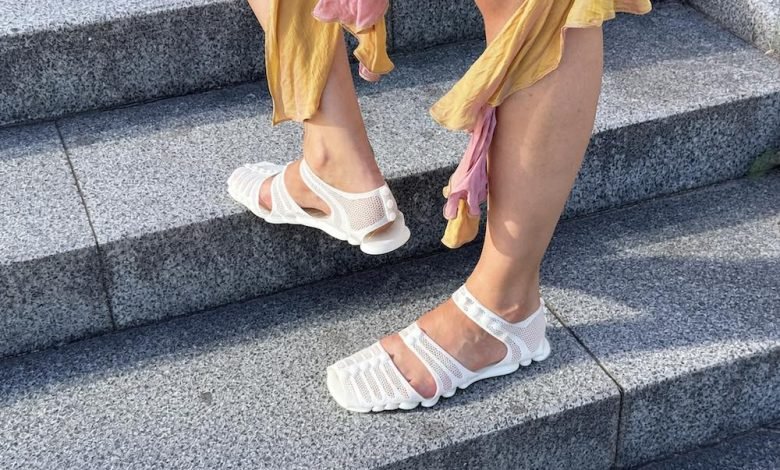
One of the more practical examples is Rousinovich’s button-fastened sandal. The design can be printed flat without supports and does not require assembly after printing.
That matters because support removal and assembly can add significant work to a desktop 3D-printing project.
The sandal also uses different textures and densities across its structure. Its sole uses a fishbone-inspired geometry, while the upper has a more porous construction designed around the characteristics of additive manufacturing.
The reported example was printed on a Bambu Lab machine using Kexcelled K8 TPU 75A flexible filament. Kexcelled produces TPU in a range of hardnesses for flexible applications, although printer settings and material characteristics can vary between specific products.
Flexible TPU is particularly relevant to footwear because printed components need to deform repeatedly during walking. However, material flexibility alone does not establish adequate durability, traction or long-term comfort.
Recent footwear-printing guidance also highlights the technical challenges involved, including repeated bending, compression, deformation and the need to balance flexibility with structural integrity.
Printable 3D Shoes Put Manufacturing Closer to the User
The significance of this release extends beyond the individual designs. Rousinovich is effectively separating footwear design from footwear manufacturing.
Traditional footwear production requires a physical manufacturing chain:
- Design the shoe
- Produce tooling or molds
- Manufacture components
- Assemble the shoe
- Ship finished products
- Sell through retailers or direct channels
Digital footwear files shorten that chain. A designer can distribute a geometry file and production instructions without manufacturing every physical unit.
For users who already own a suitable 3D printer, the model can also reduce the need for conventional inventory and shipping. The physical product is created closer to the point of use.
The trade-off is that the customer becomes responsible for production quality. A failed print, unsuitable material, incorrect sizing or poor machine setup can affect the final footwear.
What This Means for 3D Printed Footwear
Rousinovich’s release is a useful example of a broader shift from 3D-printed products to digitally distributed products.
The important development is not simply that consumers can make shoes at home. The more consequential change is that the digital file itself becomes part of the footwear business model.
A designer can potentially create one digital design and distribute it to users in different locations without physically manufacturing every pair. That makes digital distribution particularly compatible with 3D printing, where the physical product can be produced locally from the same underlying geometry.
The model also changes the role of customization.
With conventional footwear, customization generally happens inside a manufacturer’s production system. With printable footwear, modifications can potentially happen at the file level before manufacturing.
That does not mean mass-market personalized footwear has arrived. It means the technical foundation for experimenting with digitally customized footwear is becoming more accessible.
The approach also reflects a wider development in 3D printing: designs are increasingly being created around the manufacturing process itself rather than simply reproducing conventional products with a printer.
For footwear, that means considering print orientation, support requirements, variable geometry and flexible materials during the design stage.
The Reality Check: Printable Does Not Mean Production-Ready
There are still substantial limitations.
A downloadable shoe file does not automatically solve fit. Foot dimensions vary considerably, and a design that fits one user may require modification for another.
Successful printing also does not establish wear performance. A shoe can print correctly while still failing to provide sufficient grip, cushioning, fatigue resistance or durability.
Material behavior presents another challenge. TPU can provide the flexibility needed for footwear, but hardness, print settings, wall structure and infill can all change how the finished part behaves. Kexcelled, for example, offers TPU products across different Shore hardness ranges for different applications.
Production time is another practical constraint. A printable design can remove some traditional manufacturing steps, but desktop printing is not instantaneous and is unlikely to compete with conventional factories for high-volume production.
These limitations define where digital footwear currently stands: accessible enough for experimentation and small-scale production, but not yet a replacement for the industrial footwear supply chain.
What to Watch Next
The next important developments will likely come from the systems surrounding downloadable footwear rather than increasingly elaborate shoe shapes.
Fit optimization is one area to watch. Digital files could become more useful if designers incorporate foot measurements or parametric sizing directly into their models.
Material and print profiles will also matter. Standardized combinations of geometry, filament specification and printer settings could make printable footwear more predictable for consumers.
Digital licensing is another open question. As more designers distribute shoe STL files, the industry will need clearer approaches to commercial use, modifications and redistribution.
Finally, the strongest test will be whether people actually wear these products regularly. The transition from an interesting printable object to viable footwear depends on factors that photographs cannot demonstrate: comfort, durability, fit, traction and repeatability.
Rousinovich’s collection therefore represents a meaningful development in digital footwear—not because it solves those problems, but because it puts more of the footwear production process directly into a downloadable file.
Mini FAQ
Are printable 3D shoes available as digital files?
Yes. Some footwear designers distribute shoe designs as downloadable files that users can slice and manufacture on compatible 3D printers.
What material is used for 3D printed shoes?
Flexible TPU is commonly used for wearable 3D-printed footwear because it can provide elasticity and abrasion resistance. The appropriate hardness and print settings depend on the design and intended use.
Can you 3D print shoes at home?
Yes, some footwear designs are specifically developed for desktop FDM/FFF printers. However, printer capability, flexible-filament handling, sizing and print settings all affect the final result.